Normal blood work is a common result when people see a doctor for fatigue, and it doesn't mean nothing is going on. The useful next step is a couple of weeks of tracking your sleep, energy, and daily patterns, so your follow-up can look at what the tests didn't cover.
That can feel like a let-down after waiting for results. It helps to know how common it is, and what doctors typically look at next.
Why normal results are so common
Fatigue is one of the top 10 reasons people visit primary care, according to the American Academy of Family Physicians. It also notes that lab testing without specific indications "may only change treatment in 5% of patients," and that in one study of young adults without known health conditions reporting fatigue for the first time, only 27% were diagnosed with a condition that could explain it (AAFP 2023).
So a normal panel narrows the search rather than ending it. That's where your own record comes in.
Get a copy of your results
Ask for your results with their reference ranges, or download them from your patient portal. In the US, "you have the right to see and get copies of your health information" (HHS).
Two things are worth knowing when you read them. Reference ranges come from large groups of healthy people, and "a test result that is within a reference range isn't always a guarantee of good health" (MedlinePlus). And a routine panel may not include every test fatigue can call for, which is why the list below is worth asking about.
What doctors usually check next
The AAFP guidance starts with everyday causes before rarer ones: sleep, activity, and food. Then medicines, mood, sleep disorders, and substances like alcohol. The NHS list of common causes includes not enough sleep, stress, depression, hormonal changes, recent illness, and some treatments (NHS).
A few things are worth asking about specifically, because a routine panel may not include them:
- Iron stores. MedlinePlus lists iron deficiency without anemia as a cause of fatigue (MedlinePlus). Ask whether ferritin was checked.
- Celiac disease. NICE recommends testing for people with prolonged fatigue (NICE NG20). Keep eating gluten until you're tested, because the test needs it.
- Sleep apnea. Loud snoring, gasping in your sleep, or waking often to pee are signs worth raising (NHLBI).
What to track for two weeks
The questions doctors ask about fatigue are specific, and most people can't answer them from memory. Two weeks of short notes changes that. Here's what to capture each day:
| Track | Why it helps |
|---|---|
| Bedtime, wake time, and how many times you woke up | Sleep is the first thing clinicians look at |
| Energy at the same two or three times each day (0–3) | Shows whether it's constant or has a pattern, like an afternoon crash |
| Whether you felt sleepy (could doze off) or fatigued (drained but awake) | They're different symptoms, and it helps to say which |
| Caffeine and alcohol, with times | Both affect sleep in ways that are easy to miss |
| Exercise or effort, and how long recovery took | The AAFP asks how much time you need to recover from physical or mental effort |
| Meals, and anything unusual that day | Helps spot patterns around eating or stress |
The difference between sleepy and fatigued matters more than it sounds. The AAFP describes sleepiness as "the tendency to doze off" that "responds to rest," while fatigue may not. Note which one you mean. If broken sleep is part of the picture, a sleep diary is the simplest way to see it.
Questions to bring to your follow-up
- Which tests did my panel include, and was ferritin or a celiac screen part of it?
- Could any of my medicines or supplements be contributing?
- Given my sleep notes, is a sleep evaluation worth considering?
- If nothing else turns up, what would you want me to track, and when should we review again?
That last question matters. An Australian clinical guide describes watchful waiting for four weeks and then a review as a reasonable plan when there are no warning signs (RACGP). Waiting goes much better when you arrive at the review with notes, ideally on one page.
Start today
Print the pages
The printable sleep journal holds the two weeks: last night's times each morning, then the day one line at a time, with room for your energy at the same two or three times. The two-week try sheet is there for when you and your doctor pick something to test.
Or ask your AI assistant to set it up
If you already use an AI assistant, this prompt turns the table above into a two-week plan. It works in any capable assistant. Check its privacy practices before you share health details.
Help me track my tiredness for two weeks before a follow-up appointment. Help me with the method only. Don't diagnose me or suggest medicines or supplements. If I mention weight loss I can't explain, fever or regular sweats, unusual bleeding, shortness of breath, swollen glands, confusion or dizziness, tell me to see a doctor now. If I mention thoughts of harming myself, tell me to call or text 988.

1. Ask what's going on, and write it as one question in my words, like "Why am I wiped out by mid-afternoon?"
2. Give me a daily format with one line per entry and the time: bedtime, wake time, and how many times I woke; energy at the same two or three times each day (0 to 3); whether I felt sleepy (could doze off) or fatigued (drained but awake); caffeine and alcohol; exercise and how long I took to recover; meals and anything unusual.
3. Each week, ask me: Is my energy low all day, or at certain times? What do my worst days have in common? Which days broke the pattern?
4. If effort leaves me wiped out for a day or more afterward, remind me to tell my doctor before I push harder with exercise.
5. Before the appointment, help me write the questions to bring: which tests my panel included, whether any of my medicines or supplements could be contributing, whether my sleep notes suggest a sleep evaluation, and what to track next.
6. If my doctor and I agree to try one change, help me run it for about two weeks with a daily check-in and a look-back date, and call it: helped, no clear effect, made it worse, or needs another round.
What it looks like in Kasane
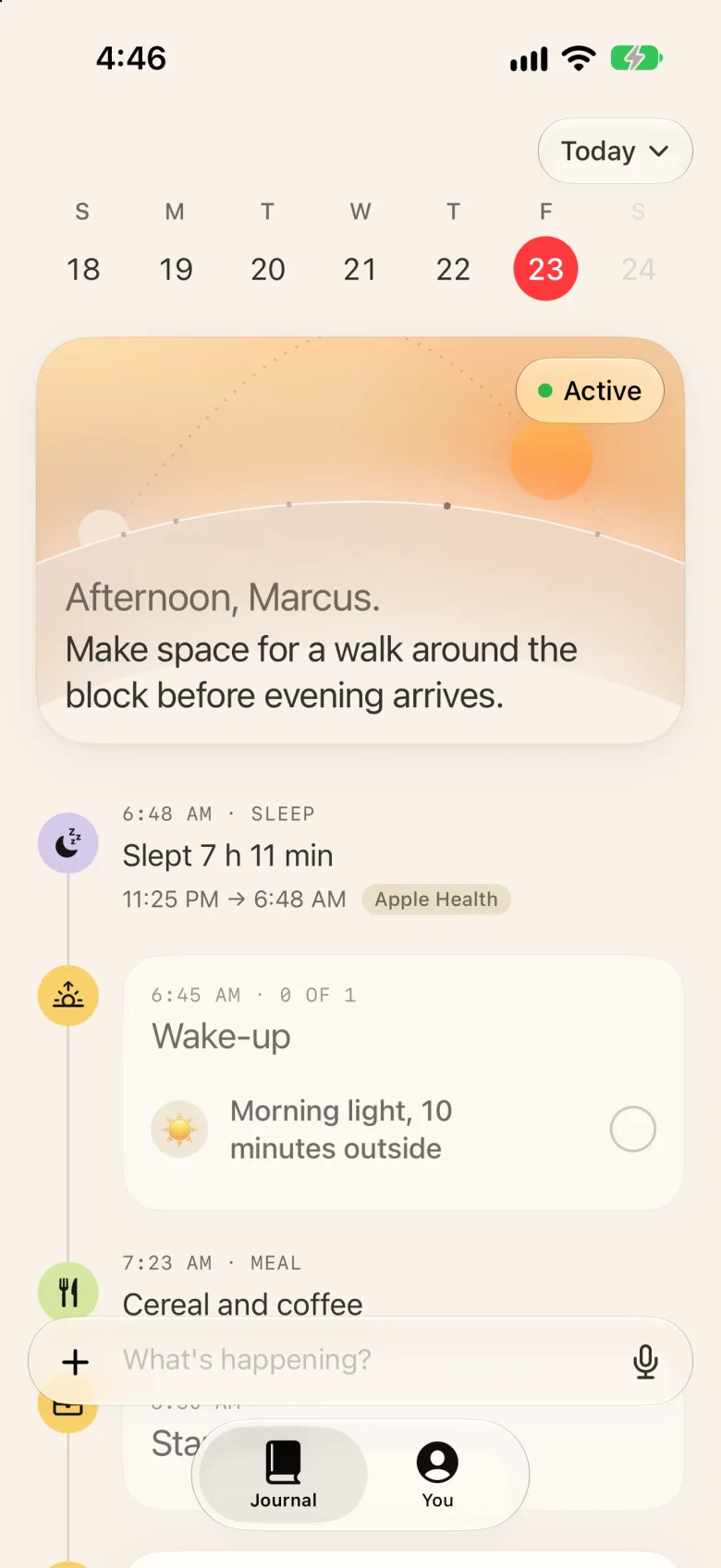
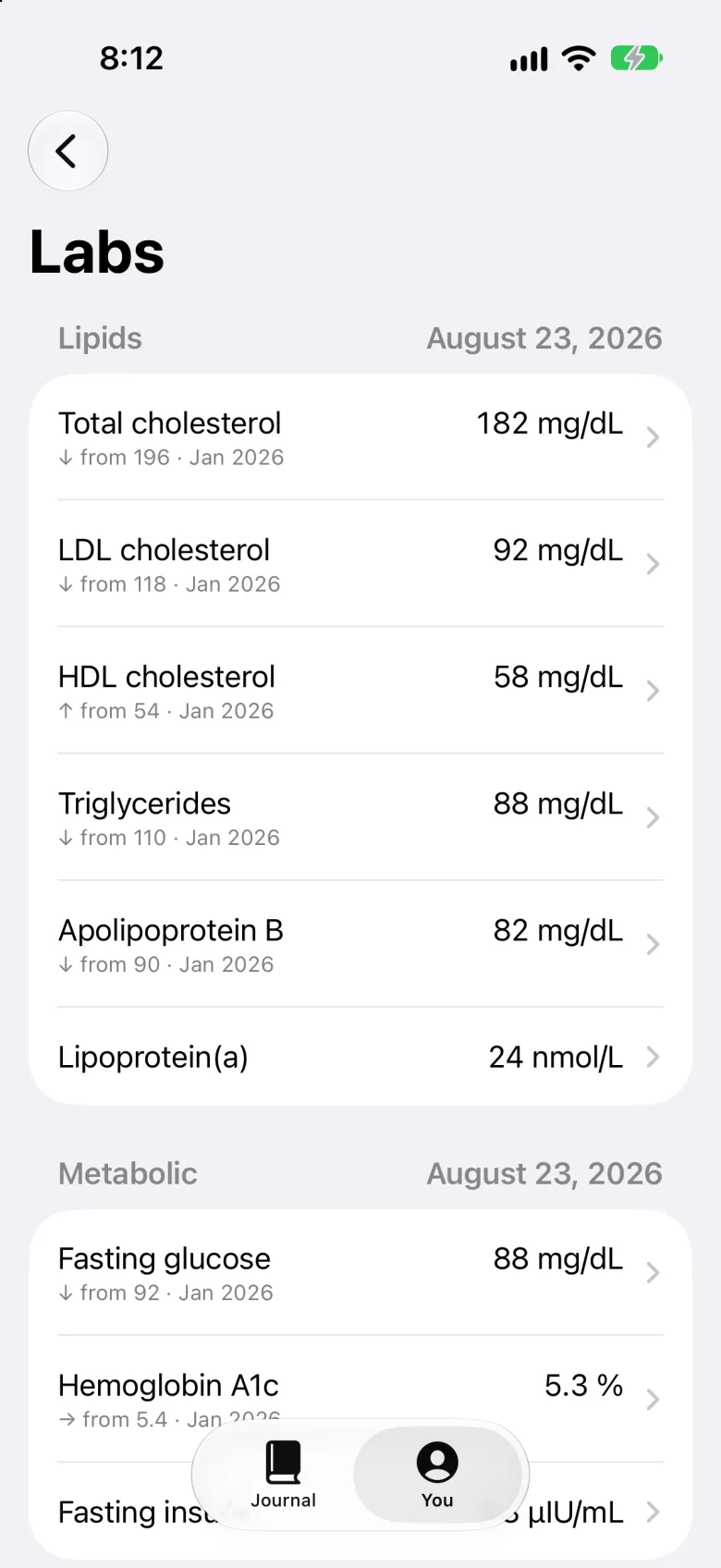
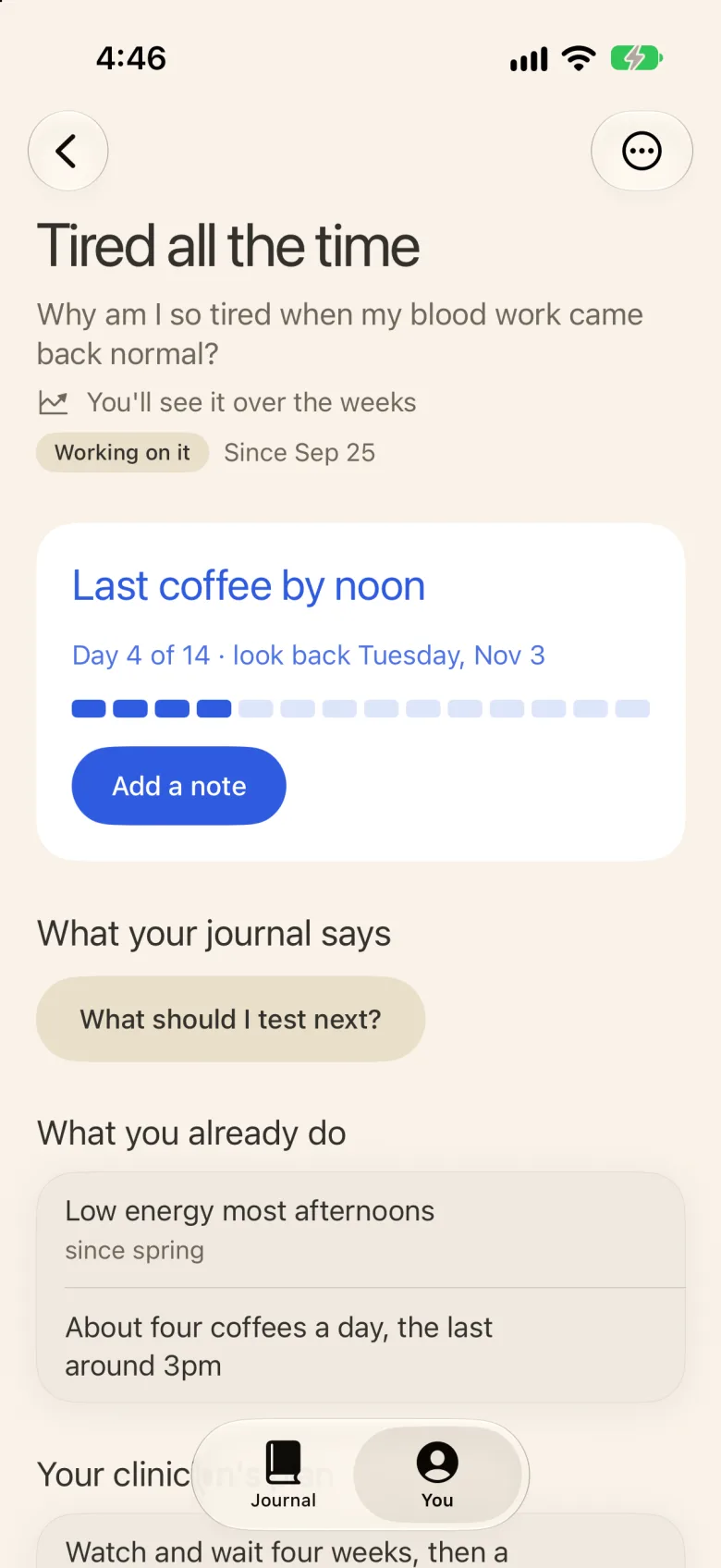
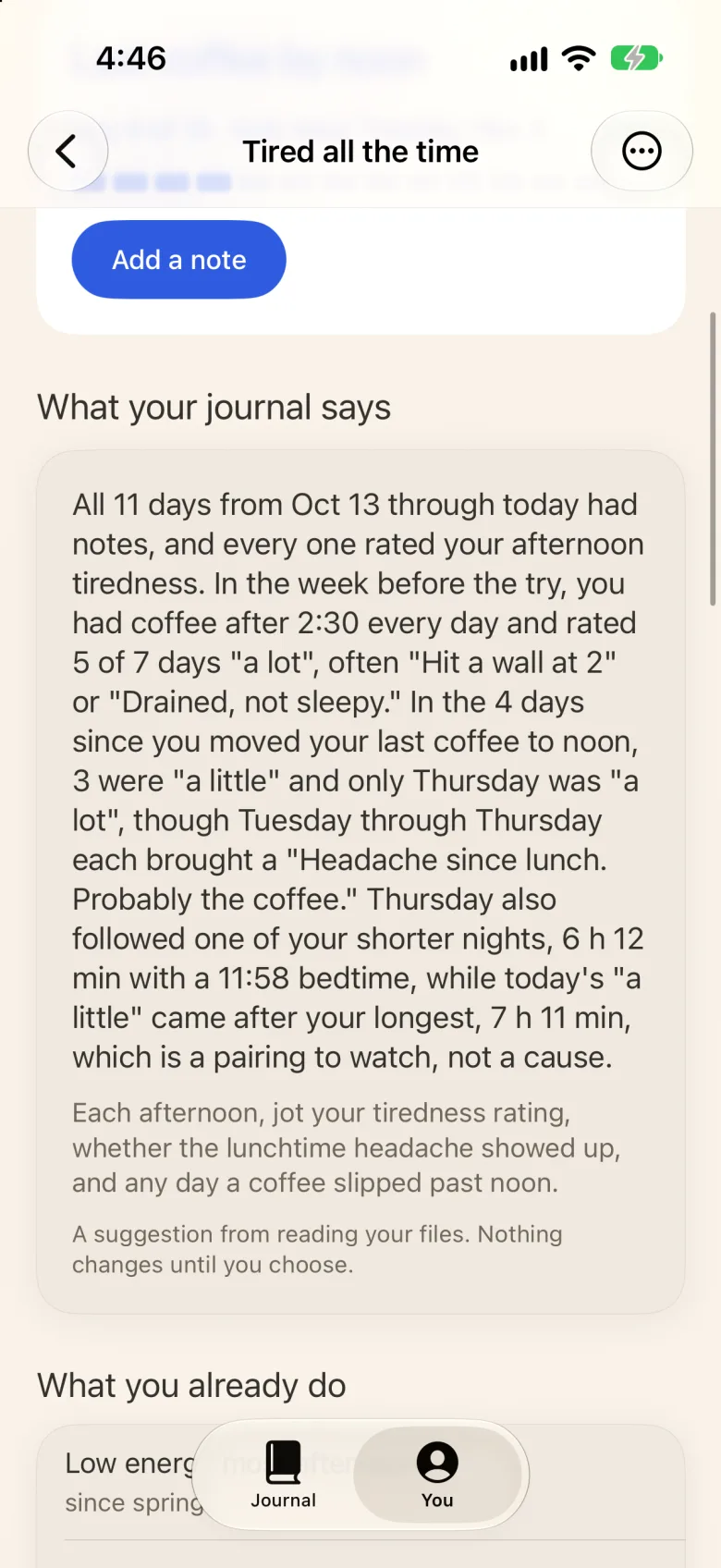
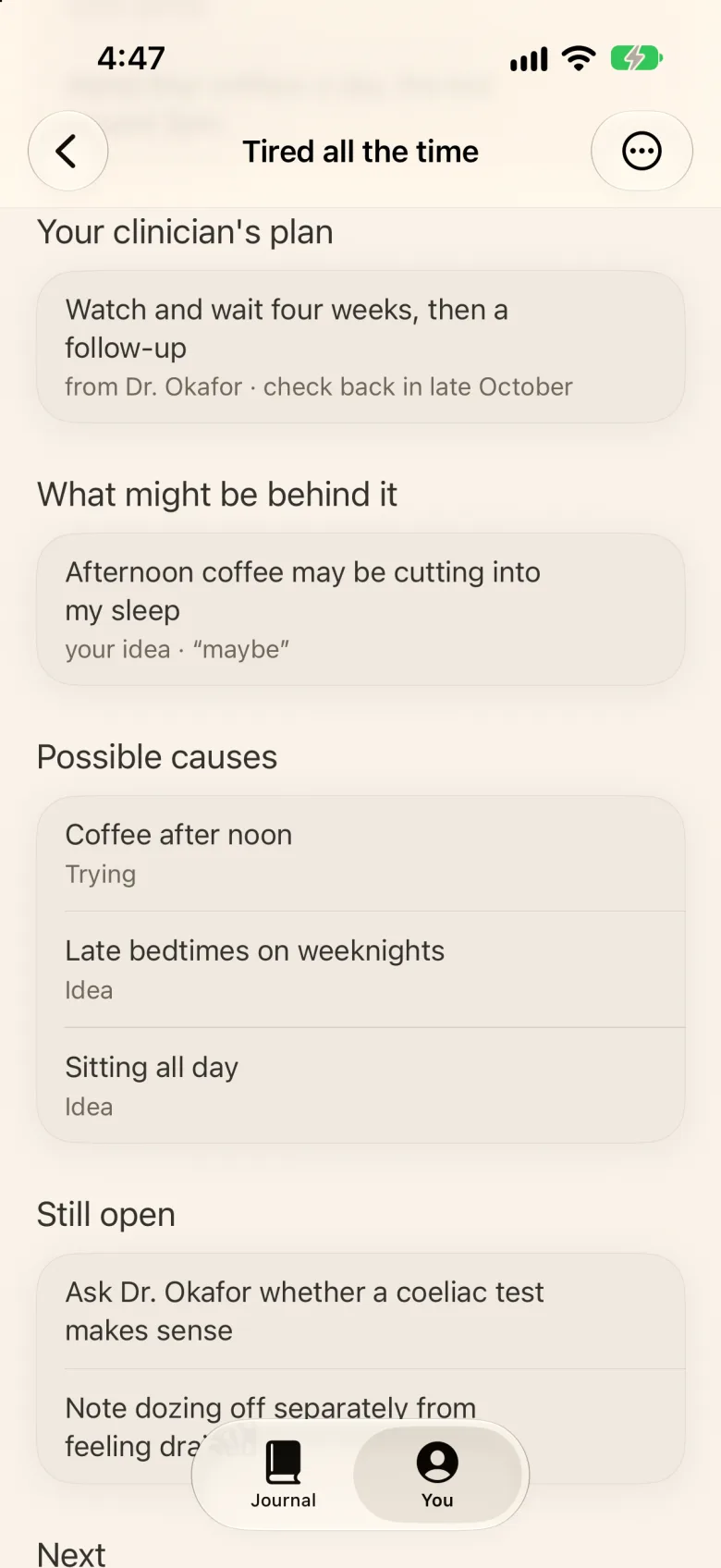
Kasane is the journal version of this two-week record. It's on the App Store for iPhone, starting with a free week: download Kasane. Here's a fictional example, step by step: Marcus, tired most afternoons since spring, with blood work that came back normal.
1. The day, as it happens
2. The labs he already has
3. He names the question, and one change
4. His journal connects the dots
5. He takes it to the follow-up
When not to wait
See a doctor promptly if fatigue comes with weight loss you can't explain, fever, unusual bleeding, shortness of breath, or swollen glands (RACGP), or with regular sweats (MedlinePlus). MedlinePlus says to contact a provider right away for confusion or dizziness, blurred vision, little or no urine, or new swelling and weight gain.
If you're having thoughts of harming yourself, call or text 988 in the US to reach the Suicide & Crisis Lifeline, any time.
And if even small efforts leave you wiped out for a day or more afterward, tell your doctor before you push harder with exercise. The AAFP notes that post-exertional malaise is the key symptom of ME/CFS, and that exercise can be harmful for people who have it.
Questions people ask
Why am I so tired if my blood work is normal?
Routine panels check for a set list of problems, and many common causes of fatigue don't show up there, including short or broken sleep, stress, mood, medicines, and some conditions that need specific tests. Normal results narrow the search rather than ending it.
Can blood work be normal and something still be wrong?
Yes. MedlinePlus notes that a result within the reference range "isn't always a guarantee of good health," and routine panels don't always include the tests fatigue can call for. In one UK audit of fatigue workups, ferritin was checked 9.4% of the time and celiac antibodies 3.2% (Handjiev et al. 2025).
What are the red flags for fatigue?
Weight loss you can't explain, fever or regular sweats, unusual bleeding, shortness of breath, swollen glands, and new fatigue in an older person who was previously well (RACGP). Confusion, dizziness, blurred vision, or very little urine need a provider right away, and thoughts of self-harm need help now: call or text 988 in the US.
Can you be tired after 8 hours of sleep?
Yes. Time in bed isn't the same as good sleep. Waking often during the night, sleep apnea, alcohol, and late caffeine can all leave you tired after a full night. A sleep diary is the simplest way to see what's happening.
Can low iron make you tired even if you're not anemic?
MedlinePlus lists iron deficiency without anemia as a cause of fatigue. Ask your doctor whether your ferritin, a measure of iron stores, was checked.
Is adrenal fatigue real?
The Endocrine Society says "no scientific proof exists" to support adrenal fatigue as a medical condition (Endocrine Society). If you're exhausted, it's worth looking at the causes above with your doctor instead.