To tell whether a change is working, write down how things are before you start, change only that one thing, check in on the same symptom every day, and decide when you'll look back. At the end, compare the two stretches and call it: helped, no clear effect, made it worse, or needs another round.
We call this a two-week try, because two weeks is a reasonable starting point for many everyday changes. That's our default rather than a guideline number. Some changes need longer, and some should never be made on your own, so this guide covers both.
The four steps
- Start with a baseline. Before you change anything, spend a week or two noting the symptom you care about. Sleep specialists ask for exactly this: the American Academy of Sleep Medicine uses a baseline sleep log of one to two weeks before trying a change (AASM).
- Change one thing. The British Dietetic Association puts it plainly: "Make one change at a time so that you can see what has helped" (BDA).
- Check in the same way every day. Same question, same scale, around the same time. "Bloated after lunch: none, a little, a lot" is enough. Decide up front what would count as better, such as fewer bad afternoons.
- Look back on the date you picked. Decide before you start when you'll judge it, so a good day or a bad day doesn't end the try early.
How long to give it
There's no single right length. Here's what the guidelines say where they say anything:
| Change | How long | Source |
|---|---|---|
| Low-FODMAP diet, first step | 2 to 6 weeks | Monash University, ACG |
| Bringing a FODMAP group back | 3 days per food group, then a 2–3 day break or until symptoms settle | Monash |
| A probiotic for IBS | At least 4 weeks, and up to 12 | NICE, BSG |
| Cutting out a single food | "A few weeks" | NHS |
| Adding fiber | Build up slowly, 2 to 3 grams a day | NIDDK |
| A sleep change | Keep logging before and during | AASM |
Two practical notes. If you're cutting caffeine, withdrawal symptoms like headache and fatigue typically start 12 to 24 hours after your last cup and can last 2 to 9 days (review), so judge the change after that window rather than in the first few days. And for probiotics specifically, gut guidelines disagree about whether they're worth trying at all, so it's a good one to ask your doctor about first.
Why feeling better isn't always proof
This is the honest part. Symptoms move around on their own. The NHS notes that IBS has "days when your symptoms are better and days when they're worse," and sleep is "highly variable across nights" too (Carney et al.).
Expectation matters as well. Across 73 IBS drug trials, 37.5% of people taking a placebo improved (Ford & Moayyedi). That doesn't mean your improvement isn't real. It means one good fortnight is a strong clue rather than a verdict.
A few habits make your result more trustworthy:
- Compare the stretches as a whole. Look at the average of the baseline and the average of the try, and let single days go.
- Keep everything else as steady as you can. A new job, a trip, or a cold can swamp the effect you're testing.
- Write the check-in down the same day. Memory rewrites how last Tuesday felt.
- Repeat it if it matters. If a change seems to help, stopping and restarting it and seeing the pattern come back is much stronger evidence than one try.
Researchers have a formal version of this called an n-of-1 trial, where one person alternates between a treatment and a comparison in randomized order (Guyatt, NEJM 1986). A two-week try is the everyday cousin: less rigorous, far easier, and a good way to arrive at your next appointment with a real observation instead of a hunch. Here's how to put it on one page for your doctor.
Start today
Print the pages
The two-week try sheet holds the four steps on one page: your question, how things are now, the one change, a check-in box for each day before and during, and the look-back with the four calls. A journal page for each day comes with it.
Or ask your AI assistant to set it up
If you already use an AI assistant, this prompt runs the four steps with you. It works in any capable assistant. Check its privacy practices before you share health details.
Help me run a two-week try: test one diet or lifestyle change and judge it fairly. Help me with the method only. Don't diagnose me, and don't suggest stopping or changing any prescribed medicine. If I mention new warning signs, such as blood in my stool, weight loss I can't explain, or diarrhea that wakes me at night, tell me to stop the try and see a doctor.

1. Ask what I want to improve, and write it as one question in my words.
2. Help me pick one daily check-in for it, with three answers (none, a little, a lot), and decide up front what would count as better, such as fewer bad afternoons.
3. Plan a baseline of one to two weeks before any change.
4. Help me choose one change and how long to give it. Two weeks is a starting point. Ask whether this change needs longer, and suggest I check with my doctor if it touches a condition I'm being treated for.
5. Set the look-back date before I start, and remind me to keep everything else as steady as I can.
6. At the look-back, if I share my check-ins, compare the two stretches as a whole, count the days in each, and call it: helped, no clear effect, made it worse, or needs another round. Remind me that one good fortnight is a clue, and that stopping and restarting the change is stronger evidence.
What it looks like in Kasane
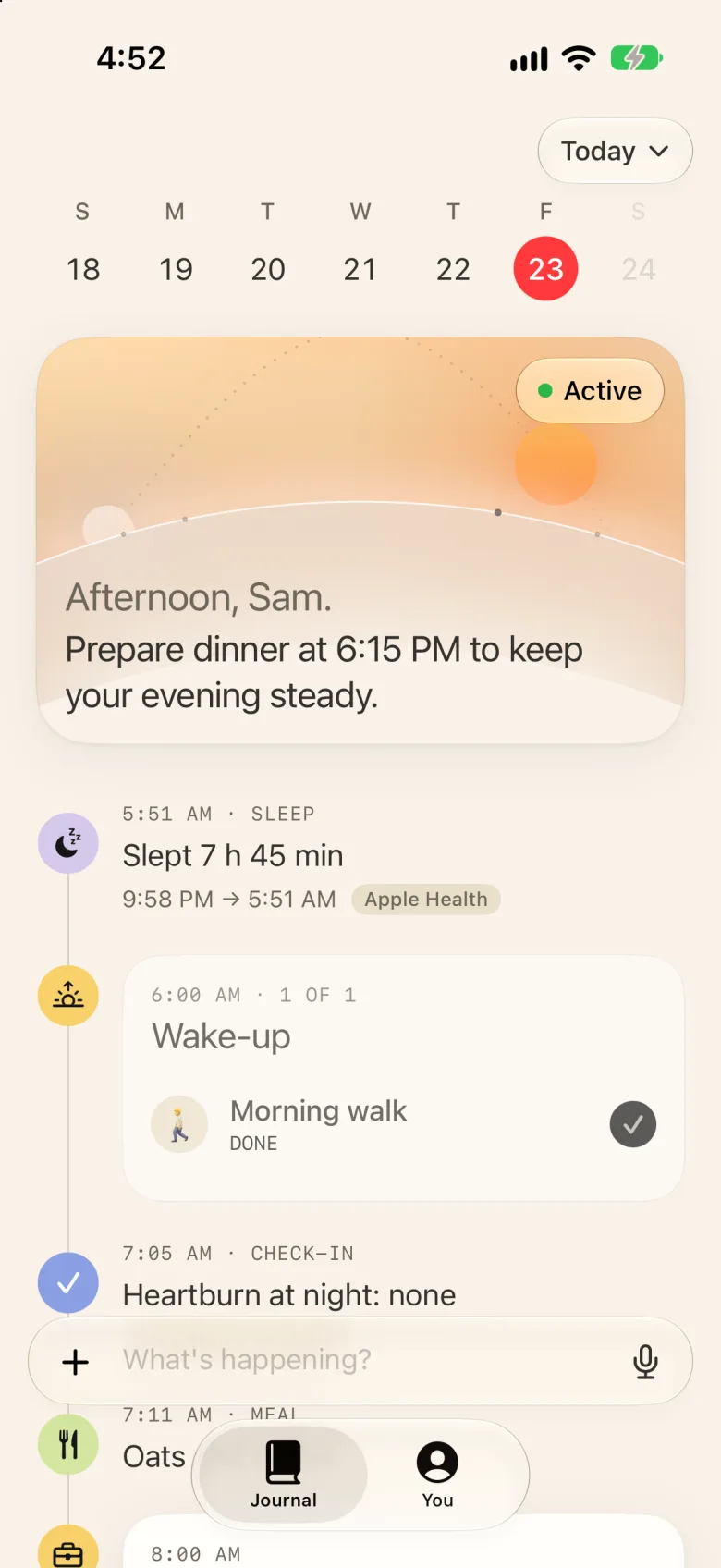
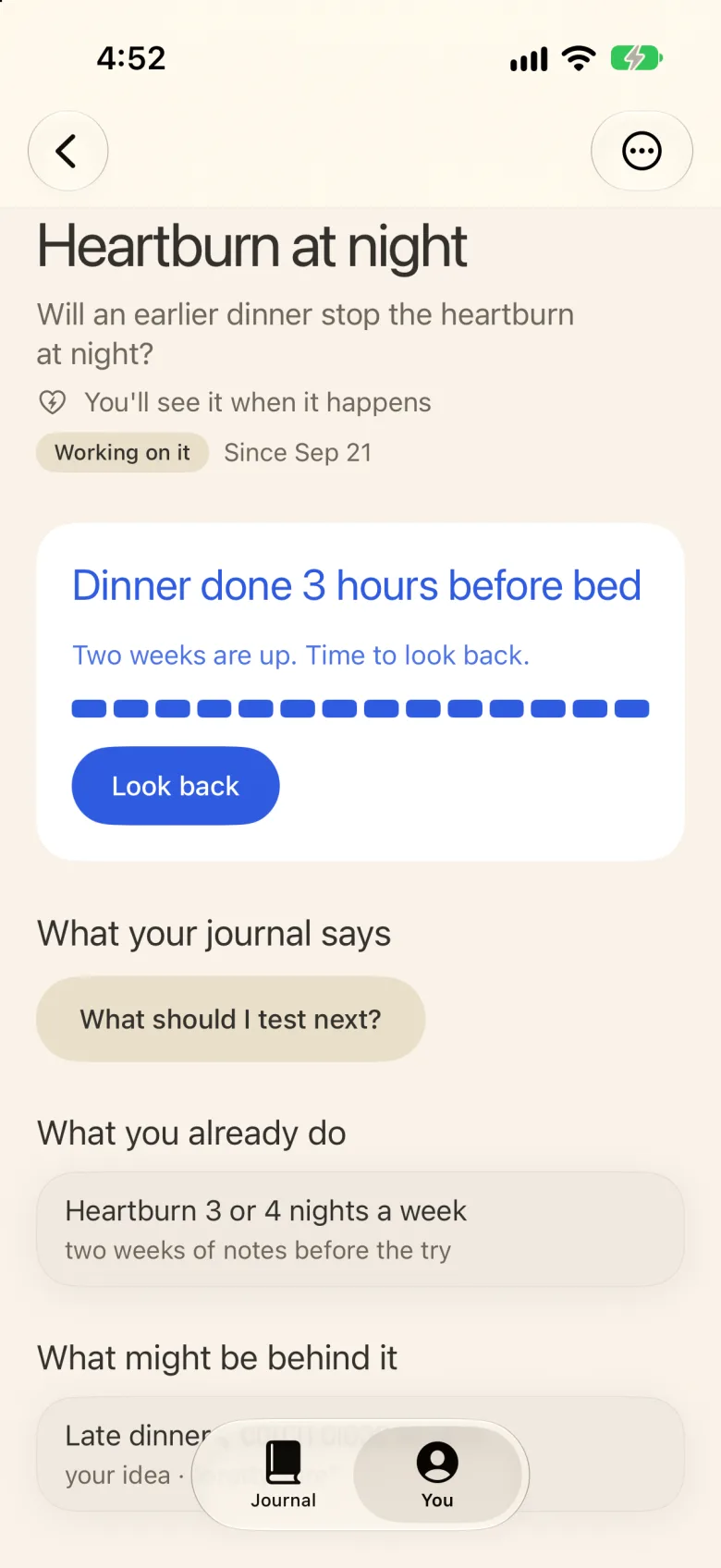
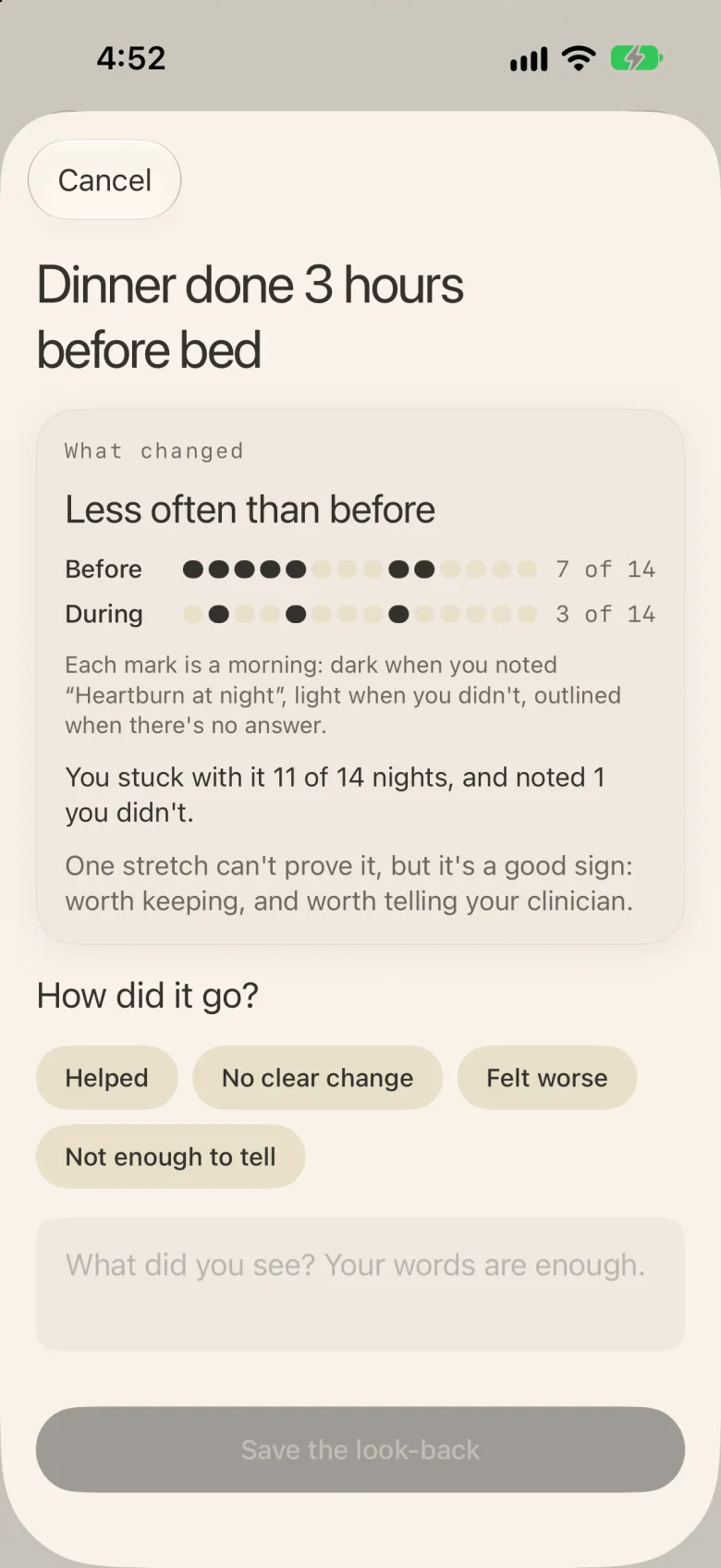
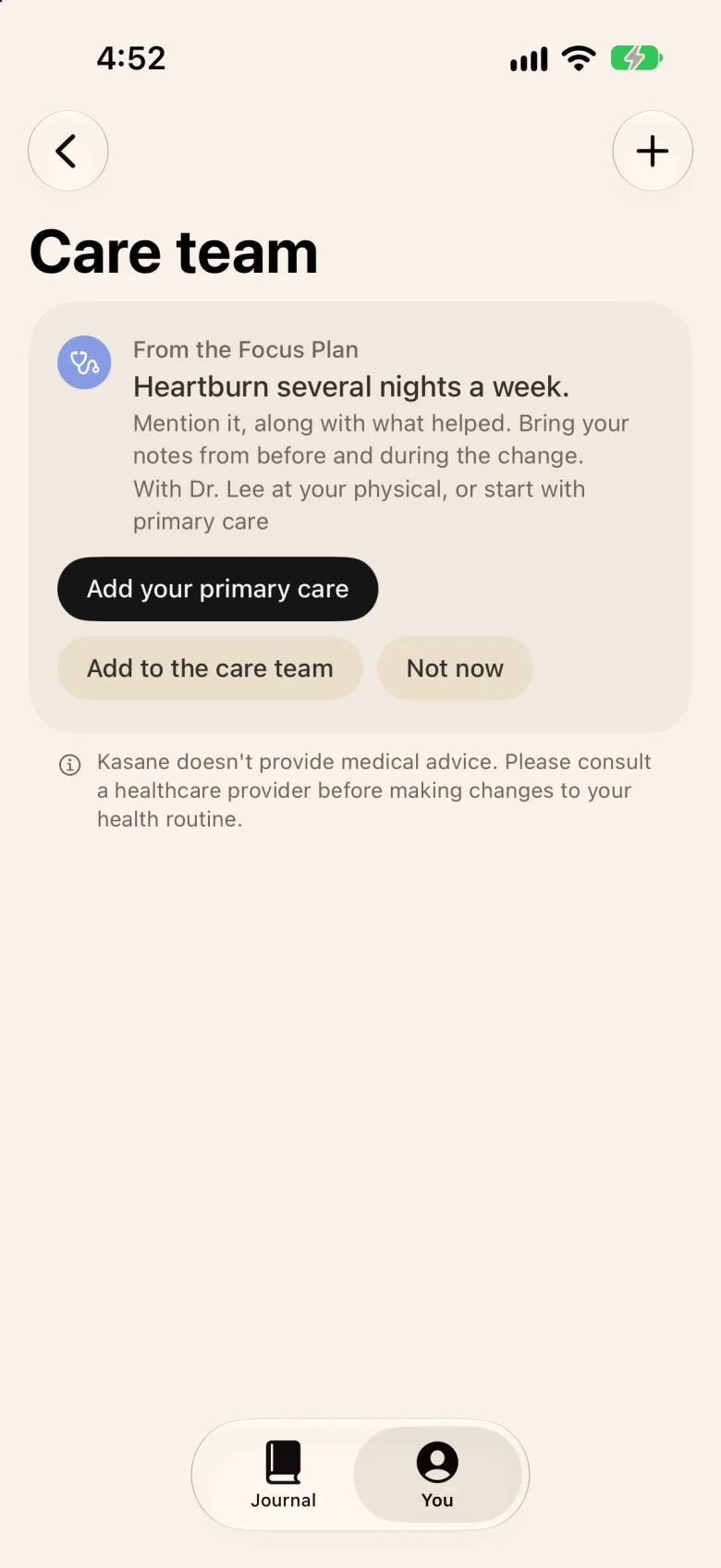
Kasane's questions and experiments run steps 2 to 4 with you: one change, the daily check-in, and the look-back on the date you set. It's on the App Store for iPhone, starting with a free week: download Kasane. Here's a fictional example, step by step: Sam, with heartburn 3 or 4 nights a week.
1. The same question, every morning
2. One change, for two weeks
3. He looks back
4. He tells his clinician what helped
What not to change on your own
- Prescribed medicines. Never stop or change a prescription to test it. Talk to the doctor who prescribed it first.
- Gluten, if celiac disease is possible. The blood test needs you to keep eating gluten, in more than one meal a day for at least 6 weeks beforehand (NICE NG20). Get tested first.
- Anything that makes you cut many foods at once. If you find yourself avoiding more and more foods to feel okay, that's a reason to see a doctor or dietitian.
Stop the try and see a doctor if new warning signs appear, such as blood in your stool, weight loss you can't explain, or diarrhea that wakes you at night. NICE says warning signs that appear during management and follow-up "should prompt further investigation" (NICE).
Questions people ask
How do you know if a supplement is working?
Start with your doctor or pharmacist: ask whether it's right for you, what change to watch for, and when to review it. The NIH suggests asking "What are its potential benefits for me?" and "How, when, and for how long should I take it?", and telling them everything you take, because "supplements can also interact with some medicines" (NIH ODS). A daily note on the symptom you care about shows what changed while you took it, though, as with any try, feeling better on its own doesn't prove the supplement did it.
How long does it take for a supplement to work?
It depends on the supplement, and for most there's no guideline number. For probiotics in IBS, NICE suggests at least four weeks while you monitor the effect, and the British Society of Gastroenterology says up to 12. For anything else, pick a length before you start, check in daily, and ask your doctor what a fair trial would be.
How long should I try a diet change before deciding?
For low-FODMAP, the first step runs 2 to 6 weeks. For cutting a single food, the NHS describes a few weeks before reintroducing it. Two weeks is our starting point for many everyday changes, with the exceptions above.
How do I know if it's the change or just a good week?
You can't be certain from one try, because symptoms vary and expectation plays a part. Compare against your baseline, keep other things steady, and if it matters, stop and restart the change to see whether the pattern repeats.
Should I tell my doctor about a change I'm trying?
Yes, especially before changing anything related to a medicine or a condition you're being treated for. A written record of what you tried, for how long, and what happened is also useful to bring to your next appointment.