Waking in the night and struggling to get back to sleep is a common sign of insomnia, and it can have several causes, including stress, alcohol, caffeine timing, a warm room, reflux, medicines, or a sleep disorder. A sleep diary kept for one to two weeks helps you and your doctor look for patterns, and it's what sleep specialists ask for before a first visit.
There's a lot online about what 3am in particular "means." We couldn't find good evidence for a special 3am cause. A more useful question is what's different about the nights you wake up.
What counts as a problem
Brief wakings are a normal part of sleep. You cycle through stages several times a night, you "usually have more REM sleep later in the night," and you "may wake up briefly between cycles" (NHLBI).
It becomes a problem when you can't get back to sleep. The NHS lists waking several times a night, and waking early and not getting back to sleep, as insomnia symptoms. Insomnia that lasts three months or longer is called long-term insomnia (NHS). The US National Heart, Lung, and Blood Institute describes chronic insomnia as happening three or more nights a week for three months or longer (NHLBI).
A rough week now and then is normal. A pattern that keeps showing up is worth two weeks of attention.
What to write in a sleep diary
The American Academy of Sleep Medicine recommends "a two-week sleep log to identify general patterns," and its patient site says a typical sleep diary covers two weeks (AASM). The research-standard Consensus Sleep Diary is filled in each morning, within an hour of getting up (Carney et al.).
Here's a simple version built from it and the NHLBI's suggestions. Fill in the evening column the next morning too:
| Each morning | Each evening |
|---|---|
| Time you got into bed, and when you tried to sleep | Caffeine: last cup and the time |
| About how long it took to fall asleep | Alcohol: how much and the time |
| How many times you woke, and roughly how long | Dinner time, and anything heavy or spicy late |
| Time you woke for the day, and time you got up | Exercise, and when |
| How well you slept (poor, fair, good) | Anything stressful on your mind |
| Naps yesterday, and how sleepy you felt during the day | Any medicines or sleep aids you took |
A few tips make it easier to keep and more useful:
- Fill it in once, in the morning. Estimates are fine. You're looking for patterns, and precision doesn't add much.
- Don't check the clock in the night to fill it in. The NHLBI notes that watching the clock can raise your risk of insomnia. Rough guesses in the morning work better.
- Track the evening too. If there is a pattern, the evening details are where you'll see it side by side.
The usual suspects to look for
These are the common causes the NHS and sleep research point to. Your diary can show which ones tend to line up with your bad nights.
- Alcohol. A research review found sleep is disrupted in the second half of the night after drinking near bedtime (Thakkar et al.). Sleep specialists don't recommend it as a sleep aid.
- Caffeine timing. The NHS suggests no tea or coffee at least 6 hours before bed. In a small study, 400 mg of caffeine taken 6 hours before bedtime still disrupted sleep (Drake et al.).
- Stress, anxiety, or low mood. Among the most common causes on the NHS list.
- Your room. Noise, light, and a room that's too hot or too cold.
- Reflux. Heartburn is often worse lying down; the NHS advises not eating within 3 or 4 hours of bed (NHS).
- Waking to pee. Caffeine and alcohol "with or after dinner" can cause it, and so can some medicines and conditions (MedlinePlus). It's also one of the signs of sleep apnea the NHLBI lists (below).
- Hormonal changes. Pregnancy and menopause can both disrupt sleep, the NHLBI notes.
A diary can miss things too. In that caffeine study, diaries picked up the disruption when caffeine was taken at bedtime or 3 hours before, but when it was taken 6 hours before bed, "only the objective measure detected differences" (Drake et al.). If your diary shows no clear pattern, that's still useful to bring to a doctor.
What to do when you wake up
Sleep specialists suggest the same few things:
- Leave the clock alone. The NHLBI notes that watching the clock can raise your risk of insomnia, and you can estimate the time in the morning.
- If you can't get back to sleep, get up. Insomnia treatment includes "getting out of bed if you cannot sleep" (NHLBI). The AASM's rule of thumb is about 20 minutes, then a quiet activity without a lot of light (AASM). NINDS suggests "reading or listening to calming music, until you feel tired" (NINDS).
- Go back to bed when you feel sleepy. Going to bed only when sleepy, and keeping the bed for sleep, are part of the same approach, called stimulus control.
If waking has become a pattern that lasts months, ask your doctor about cognitive behavioral therapy for insomnia (CBT-I). The AASM gives it a strong recommendation for chronic insomnia in adults (AASM 2021), and the NHLBI says it's "usually recommended as the first treatment option for long-term insomnia."
If you try a change
The NHS's self-help advice for insomnia includes avoiding tea or coffee in the 6 hours before bed, and its list of causes includes noise and a room that's too hot or too cold. If you try one, change one thing at a time and keep the diary going, so you can see what happened afterward. A pattern is something to discuss with your doctor; it doesn't prove the cause. Here's how to tell whether a change is working.
6 hours before bed 7–8 pmLast meal, if reflux is a suspect
3 to 4 hours before bed 11 pmBed
Sleep varies from night to night, so compare patterns across several nights rather than judging by one. And if you're cutting back on caffeine, withdrawal can make the first few days feel worse before they feel better.
Start today
Print a page
The printable sleep journal gives each night one page: last night's times at the top, filled in once in the morning, then the evening one line at a time, with times. A two-week try sheet comes with it. To work out the sleep-log numbers, the sleep diary page walks through them with an example.
Or ask your AI assistant to set it up
If you already use an AI assistant, this prompt turns the diary above into a two-week plan. It works in any capable assistant. Check its privacy practices before you share health details.
Help me keep a two-week sleep diary to understand why I wake in the night, and then test one change. Help me with the method only. Don't diagnose me or suggest medicines, supplements, or sleep aids. If I mention loud snoring, my breathing stopping or gasping in my sleep, feeling very sleepy during the day, low mood that won't lift, or thoughts of harming myself, tell me to see a doctor first, and for thoughts of harming myself, to call or text 988.

1. Ask what's happening, and write it as one question in my words, like "Why do I keep waking around 3am?"
2. Give me a morning format, filled in once within an hour of getting up, with estimates: when I got into bed, about how long it took to fall asleep, how many times I woke and roughly for how long, when I woke for the day and got up, and how well I slept (poor, fair, or good).
3. Give me an evening format, one line per entry with the time: caffeine, alcohol, dinner, exercise, anything stressful, and any medicines.
4. Remind me to leave the clock alone at night.
5. After two weeks, give me questions to ask of my notes: What do the nights I woke have in common? What was different about the evenings before them? Which nights broke the pattern?
6. Help me choose one change to try for about two weeks, such as no caffeine in the six hours before bed, and the date I'll look back. One change at a time.
7. At the look-back, if I share my notes, count the mornings I woke in the night before and during the try, quote the entries you counted, and call it: helped, no clear effect, made it worse, or needs another round. Remind me that a pattern is a clue to discuss with my doctor, and say what my notes can't tell us.
What it looks like in Kasane
Kasane is the journal version of this diary. It's on the App Store for iPhone, starting with a free week: download Kasane. Here's a fictional example, step by step: Dana, who's been waking around 3am most nights since July.
1. Last night is already there
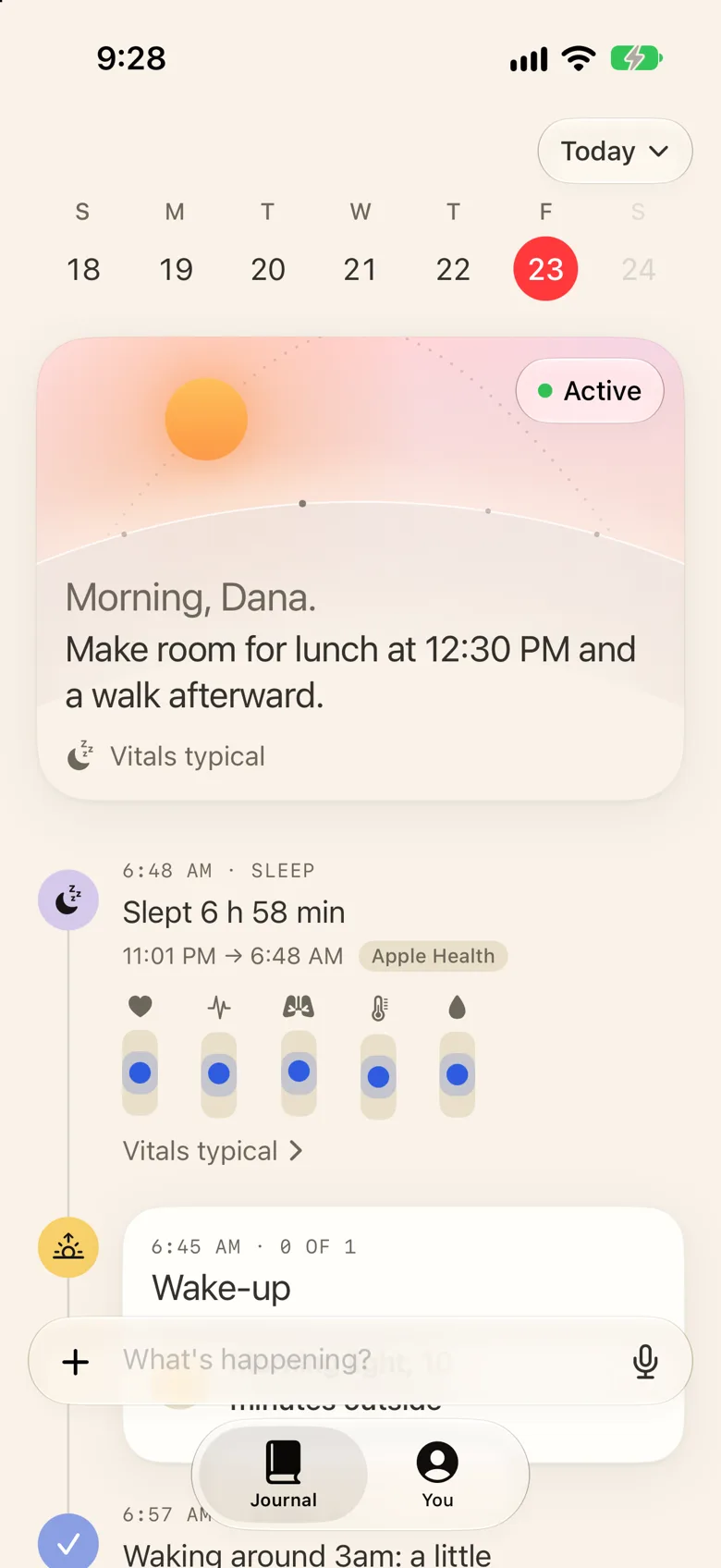
With Apple Health connected, last night is there when she opens the app: when she slept, for how long, and five overnight readings. The rest is hers to write, one line at a time, the way she'd text it: how long it took to fall asleep, how the night felt, coffee at 4.
2. She names the question, and one change
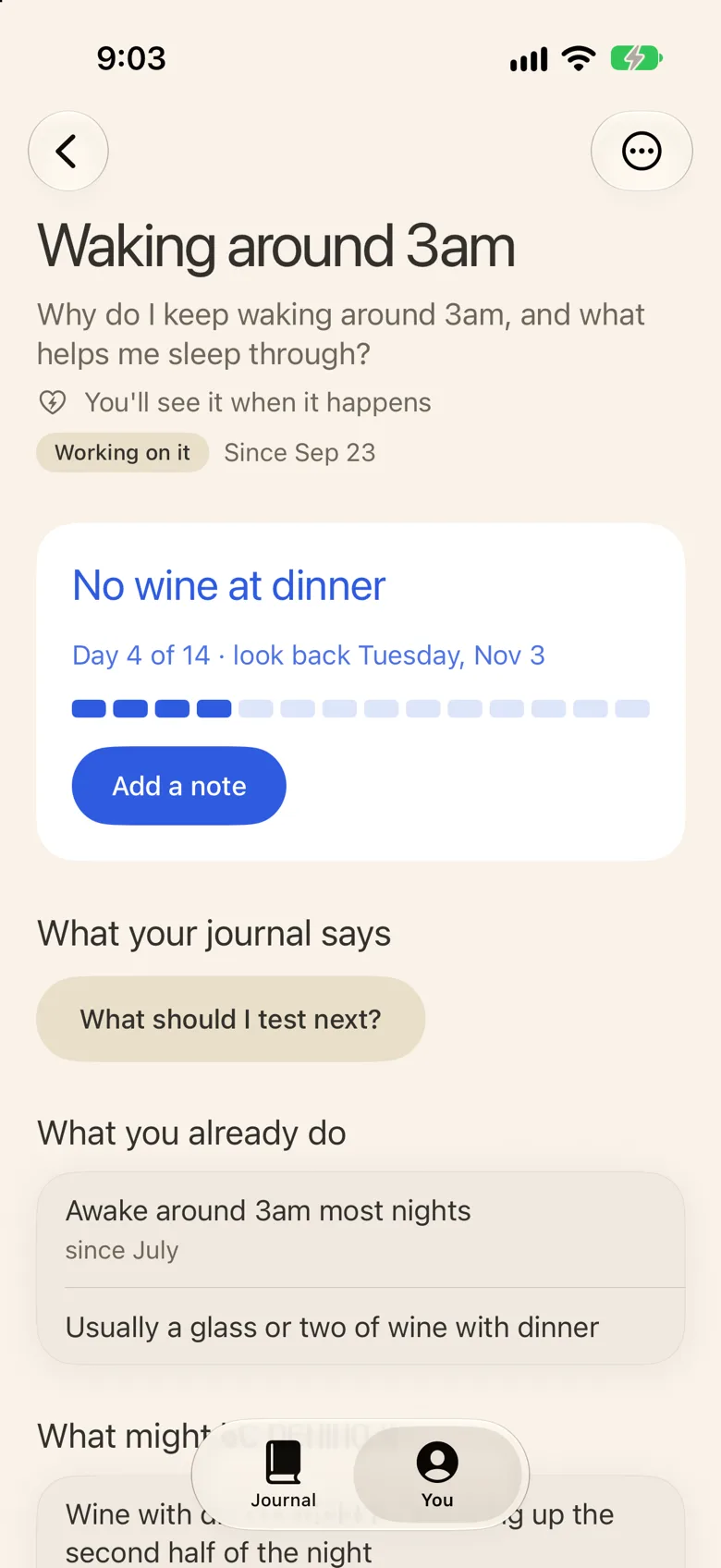
3. Her journal connects the dots
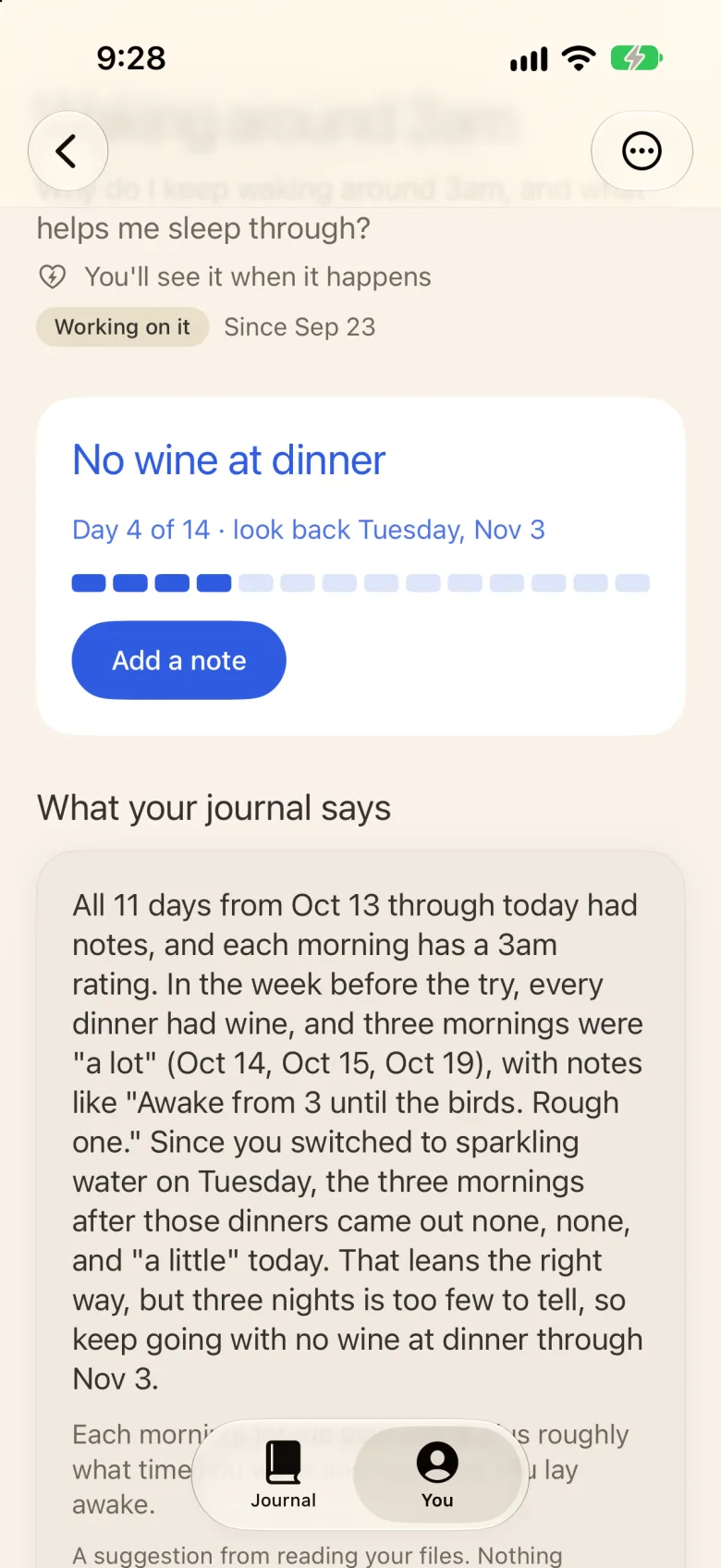
4. She looks back
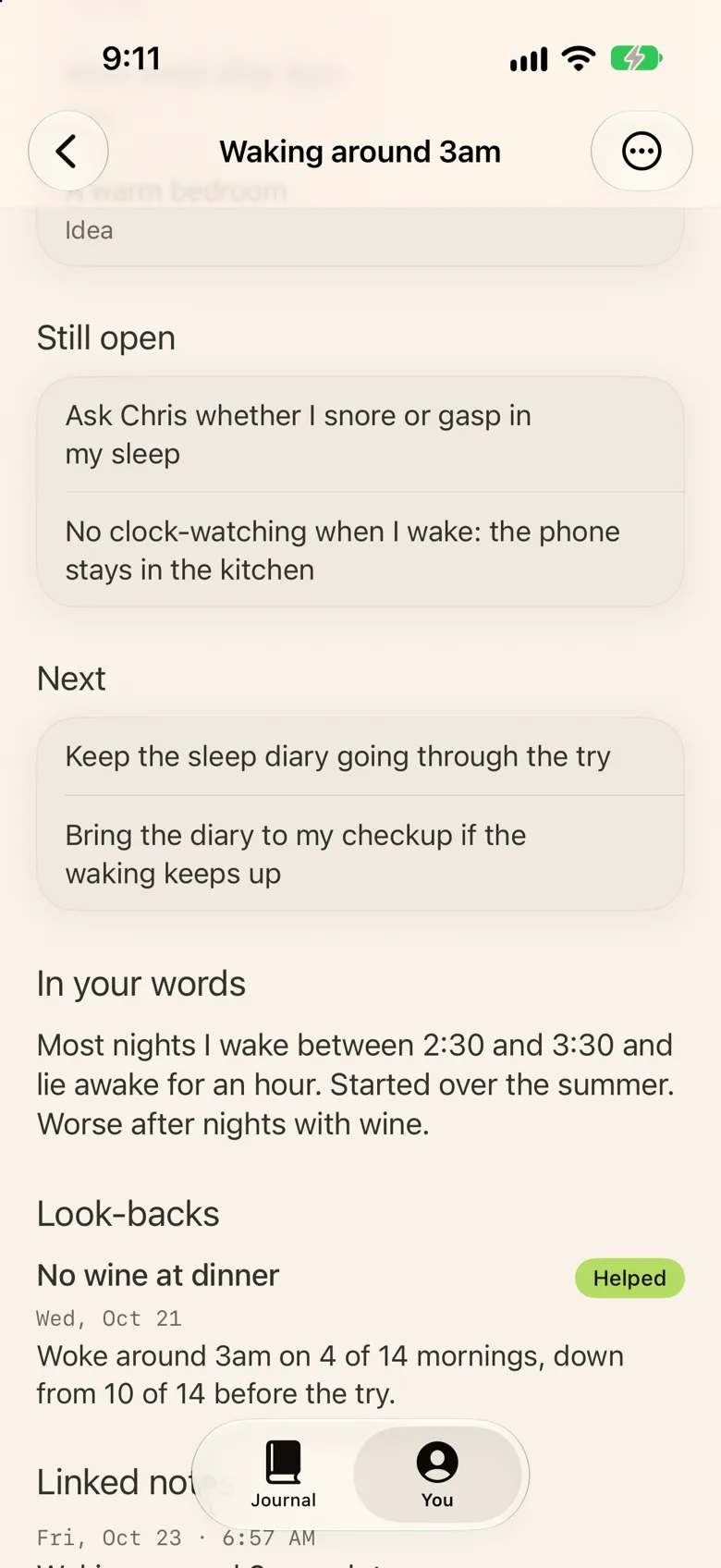
Sleep varies from night to night, so the look-back compares fourteen mornings with fourteen mornings.
5. She takes it to the visit
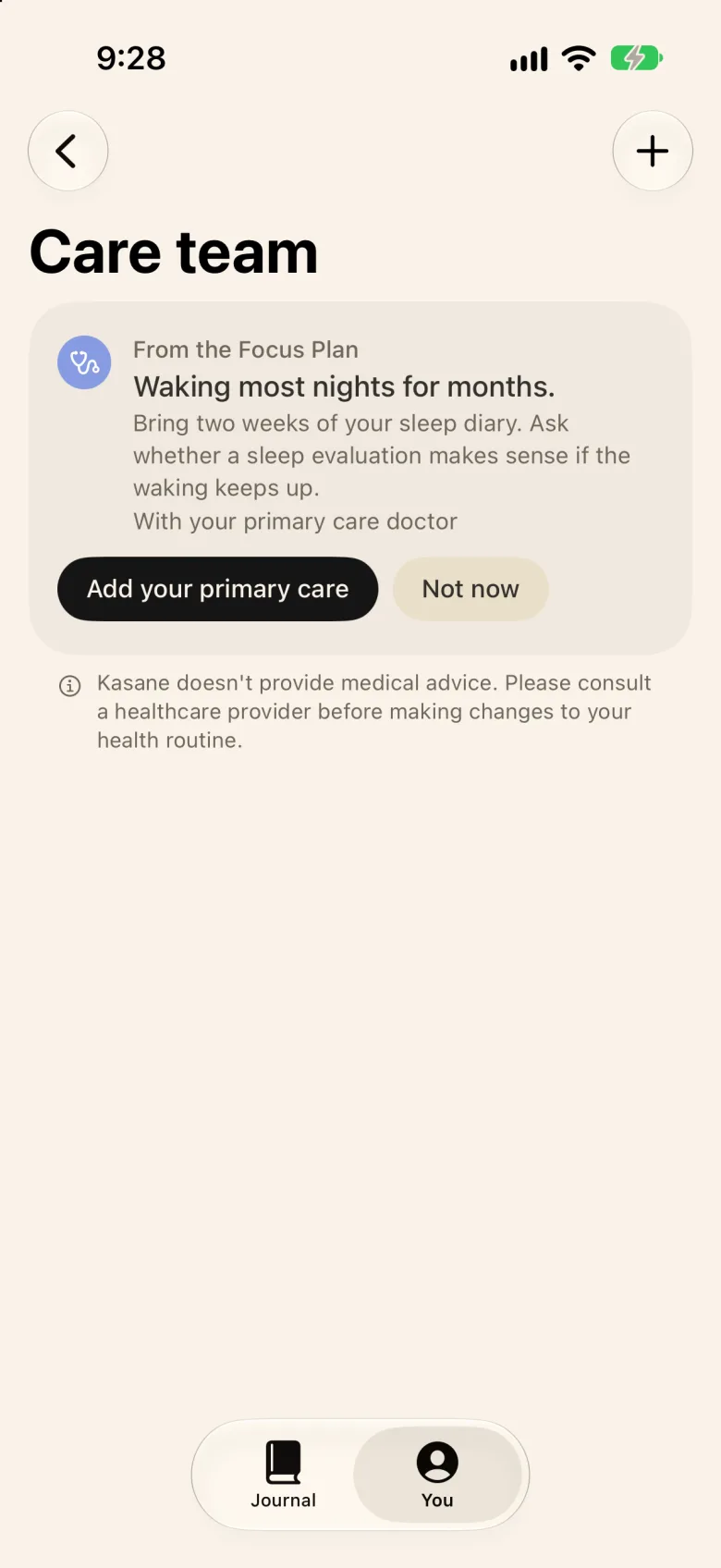
The question stays open until the waking settles or her doctor has the diary.
When to see a doctor
Bring your diary to a doctor if changing your habits hasn't helped, you've been struggling for months, or it's affecting your daily life. Here's how to put your notes on one page. See someone sooner if you notice:
- Signs of sleep apnea: loud snoring, your breathing stopping and starting, gasping or choking in your sleep, or feeling very tired during the day. A bed partner is often the one who notices, and the NHS suggests bringing them to the appointment (NHS).
- Waking often to pee along with feeling very thirsty or losing weight, which can be a sign of diabetes (NHS).
- Low mood that won't lift. Insomnia and depression often travel together. If you're having thoughts of harming yourself, call or text 988 in the US any time.
And don't drive when you feel sleepy.
Questions people ask
Why do I wake up at 3am every night?
There are several common causes, including stress, alcohol, late caffeine, a warm room, reflux, needing to pee, medicines, and sleep disorders like sleep apnea. We didn't find good evidence that 3am itself has a special cause. A one- to two-week sleep diary helps you and your doctor see what your bad nights have in common.
How do I stop waking up at 3am?
Start with a two-week sleep diary so you know what your bad nights share, then change one likely cause at a time. When you do wake, leave the clock alone, and if you can't get back to sleep after about 20 minutes, get up and do something quiet until you feel sleepy. If it's been going on for months, ask your doctor about CBT-I, the treatment sleep specialists recommend first for long-term insomnia.
What does it mean when you wake up at 3am?
Popular explanations link 3am to a particular organ, hormone, or meaning, and we couldn't find authoritative evidence for any of them. What sleep research does describe is that the later part of the night has more REM sleep and brief wakings between sleep cycles, which are normal. The question worth answering is why you can't get back to sleep.
Does waking up at 3am mean high cortisol?
That's a popular explanation online, but we couldn't find authoritative evidence for it, and the Endocrine Society says there's no scientific proof that "adrenal fatigue" is a real condition. If you're worried about a hormone problem, ask your doctor whether any testing makes sense.
Can anxiety wake you up in the middle of the night?
Yes. Stress, anxiety, and depression are among the most common causes of insomnia on the NHS list, and the AASM notes "a bidirectional increased risk between insomnia and depression." If worry or low mood is waking you, tell your doctor.
Why do I wake up at night to pee?
Your body normally makes less urine at night, so waking to pee often has a cause. MedlinePlus lists caffeine and alcohol with or after dinner, some medicines, and conditions including urinary infections, an enlarged prostate, diabetes, and sleep apnea. See a provider if it keeps happening over several days, or comes with pain, burning, or blood in your urine (MedlinePlus).
How long should I keep a sleep diary?
About two weeks. That's what the American Academy of Sleep Medicine recommends, and the NHLBI suggests one to two weeks before seeing your doctor.
Should I take melatonin for waking up in the night?
The AASM's review found melatonin had little effect on waking during the night or total sleep time. Talk to your doctor before starting any sleep aid, especially if you might have sleep apnea.