A food diary for IBS records what you ate, when your symptoms showed up, and how strong they were, next to the few other things that move your gut, like stress and sleep. It becomes useful when you change one thing at a time while you keep it, so you can see what each change actually did.
That second part is where most diaries stall. People write everything down for a month, stare at the pages, and can't see a pattern. The diary is the record. The finding comes from testing one suspect against it.
What to write down
Clinicians ask for the same few things. NIDDK describes a diary of "the foods and drinks you consume and when your gas symptoms occur" (NIDDK), and the NHS gives the same advice for IBS (NHS). The diary that Monash University uses for its low-FODMAP program adds symptom type, severity, bowel habit, and stress (Monash).
Here's a simple daily template built from those fields:
| When | What you ate or drank | Symptom and strength (0–3) | Bowel movement | Stress, sleep, medicines |
|---|---|---|---|---|
| 7:30 am | Oats, berries, coffee | None | Type 4 | Slept 7 hours |
| 12:30 pm | Ramen at work | None | Busy morning | |
| 3:00 pm | Bloating, 3 | |||
| 7:00 pm | Rice, salmon, greens | Bloating easing, 1 | Type 5 | Ibuprofen for a headache |
A few notes that make it easier to read later:
- Write the time. Food intolerance symptoms usually arrive "a few hours after eating" (NHS), so the gap between the meal and the symptom matters more than which meal came last.
- Use a small scale for strength. A 0–3 score is enough to compare days. Precision doesn't help much here.
- For bowel movements, the Bristol Stool Form Scale is the shared language doctors use, and NICE suggests it for describing stool form (NICE).
- Note medicines and supplements, including ones you take now and then. Doctors ask about them, and some affect the gut.
- Skip calories. You're looking for timing and patterns, and counting calories adds work without helping.
How long to keep it
Longer than you'd like, and for as long as you're making changes. The British Dietetic Association puts it simply: "Keep a food and symptom diary whilst you are making changes" (BDA). IFFGD, the US foundation for gut disorders, suggests a daily symptom diary for 2 to 4 weeks (IFFGD). We couldn't find a guideline that promises a trigger in a set number of days, so be wary of anyone who does.
Start with a baseline: a week or two of your normal eating. That's our suggested minimum rather than a guideline number, and longer is better if you can manage it. Then the diary keeps running while you test one change.
Change one thing at a time
This is the part that turns a diary into an answer. The BDA says to "make one change at a time so that you can see what has helped" (BDA), and Monash reintroduces foods "one at a time, so you get clear results" (Monash).
If you cut dairy, wheat, and coffee in the same week and feel better, you've learned that something in that pile matters. You haven't learned which one.
It also protects you from a common trap. When people who report a reaction to a food are re-tested with it, the ACG notes that "only 2%–3% develop recurrent symptoms" (ACG 2021). Plenty of foods get blamed for a bad day that had other causes. Testing one at a time is how you find out, and here's how to tell whether a change is working.
If you try low-FODMAP
Low-FODMAP is one of the diets IBS guidelines cover in detail, and it has a clear shape. Monash runs it in three steps:
- Swap high-FODMAP foods for low-FODMAP ones for 2 to 6 weeks. The ACG agrees that responders can be identified in 2 to 6 weeks.
- Reintroduce one FODMAP group at a time, eating a food rich in that group for 3 days, then taking a 2–3 day break, or until symptoms settle, before the next test. Monash says the reintroduction step takes most people about 6 to 8 weeks (Monash).
- Personalise: keep avoiding only the foods that triggered you, and bring everything else back.
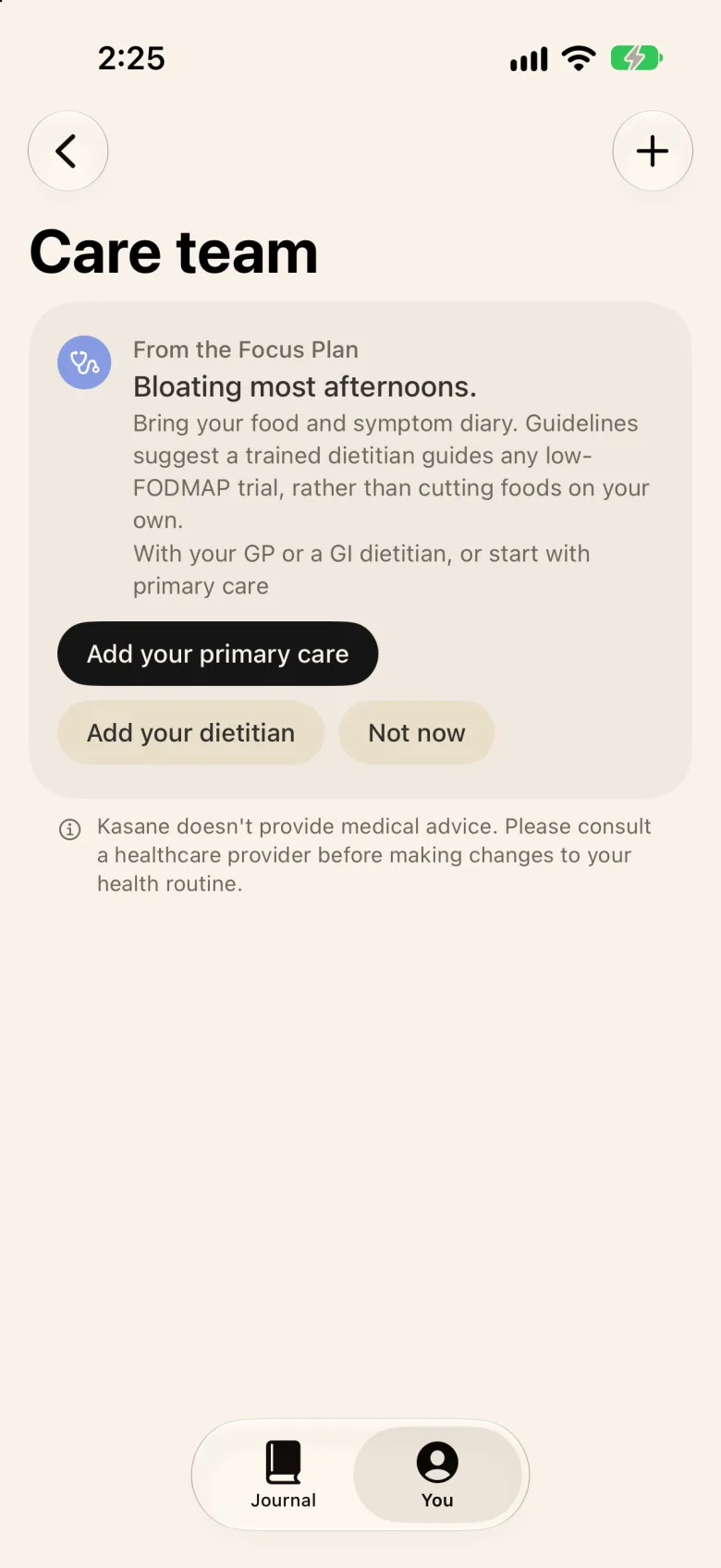
It doesn't work for everyone. Monash says about three quarters of people with IBS improve on it. And it isn't meant to be forever: step 3 exists to loosen the diet, because over-restricting can cut nutrients you need. NICE recommends advice from a professional with expertise in diet, and the British Society of Gastroenterology says a trained dietitian should supervise it (BSG 2021).
Before you cut out gluten
If there's any chance of celiac disease, get tested before you cut gluten. The blood test only works while you're still eating it: NICE advises gluten in more than one meal every day for at least 6 weeks before testing (NICE NG20). Going gluten-free first can make the result wrong. The food sensitivity guide covers the tests that do help, and when.
Start today
Print a page
The printable food and symptom journal gives each day one page, one line per entry: the time, the kind, and what happened in your words. A two-week try sheet comes with it, so the baseline, the one change, and the look-back sit on one page.
Or ask your AI assistant to set it up
If you already use an AI assistant, this prompt turns the method above into a plan you can follow. It works in any capable assistant. Check its privacy practices before you share health details.
Help me keep a food and symptom diary for my gut symptoms and test one change at a time. Help me with the method only. Don't diagnose me or suggest medicines or supplements. If I mention blood in my stool, black or tarry stools, weight loss I can't explain, diarrhea that wakes me at night, or symptoms that are new or getting worse, tell me to see a doctor first.

1. Ask what's bothering me, and write it as one question in my words, like "What's making me bloated after lunch?"
2. Give me a daily format with one line per entry: the time, the kind (meal, drink, symptom with a 0 to 3 strength, bowel movement by Bristol type, medicine, stress, sleep), and what happened in my words. No calories.
3. Pick one daily check-in for my question, answered none, a little, or a lot, at about the same time each day.
4. Plan one to two weeks of my usual eating as a baseline before any change.
5. Help me choose one change to try for about two weeks, and the date I'll look back. One change at a time. Don't suggest cutting several foods at once, going gluten-free before I've been tested for celiac disease, or starting low-FODMAP without a dietitian.
6. Give me three questions to ask of my notes each week, such as: What did I eat in the few hours before my worst afternoons? Which days broke the pattern? What else was different on those days?
7. At the look-back, if I share my notes, compare the baseline and the try as whole stretches. Count the days with symptoms in each, quote the entries you counted, and call it: helped, no clear effect, made it worse, or needs another round. Say what my notes can't tell us.
What it looks like in Kasane
Kasane is the journal version of this method. It's on the App Store for iPhone, starting with a free week: download Kasane. Here's a fictional example, step by step: Priya, who's bloated most afternoons and a few days into a two-week try.
1. The day, written the way she'd text it
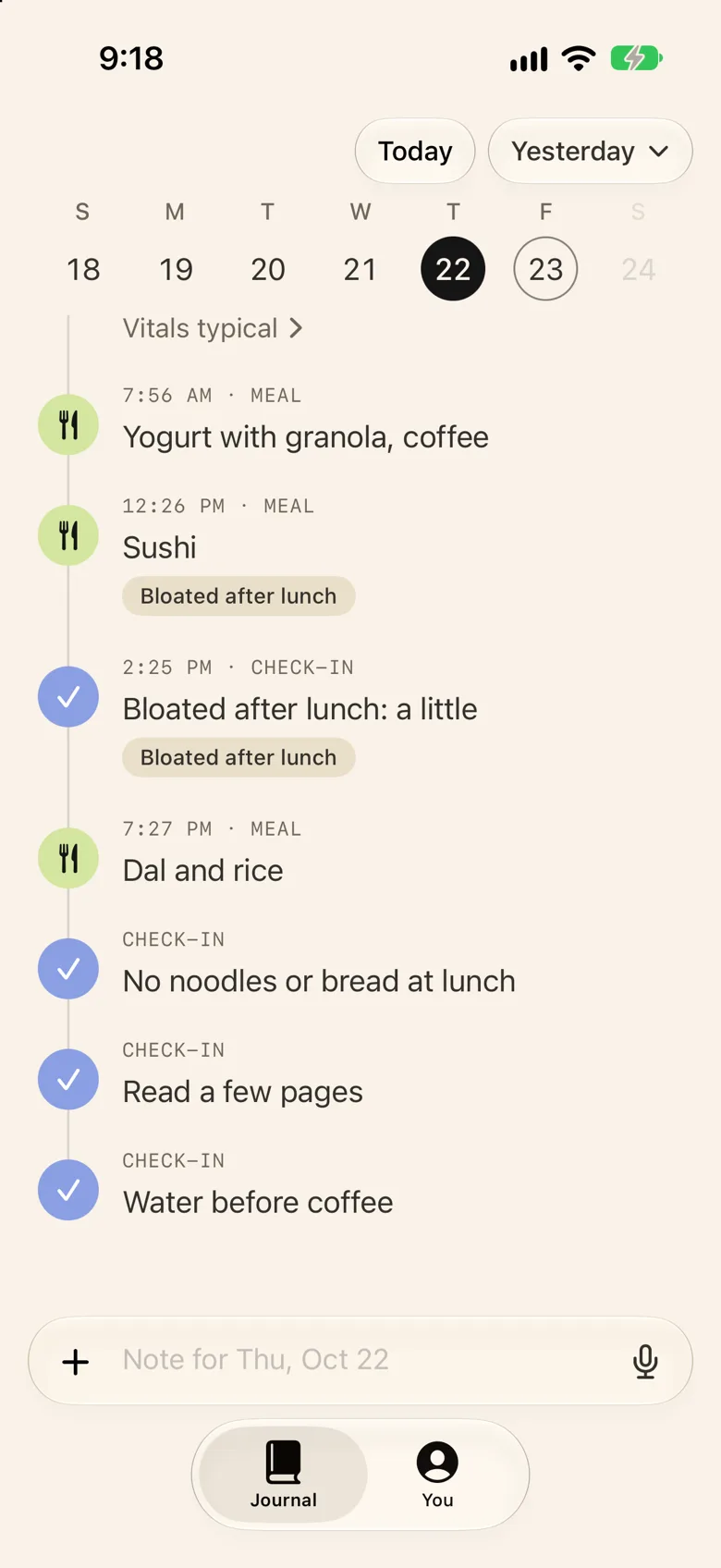
The diary is the same one described above, written in sentences: Priya writes what she ate or how she feels, and each line lands at its time with a kind attached.
2. She names the question, and one change
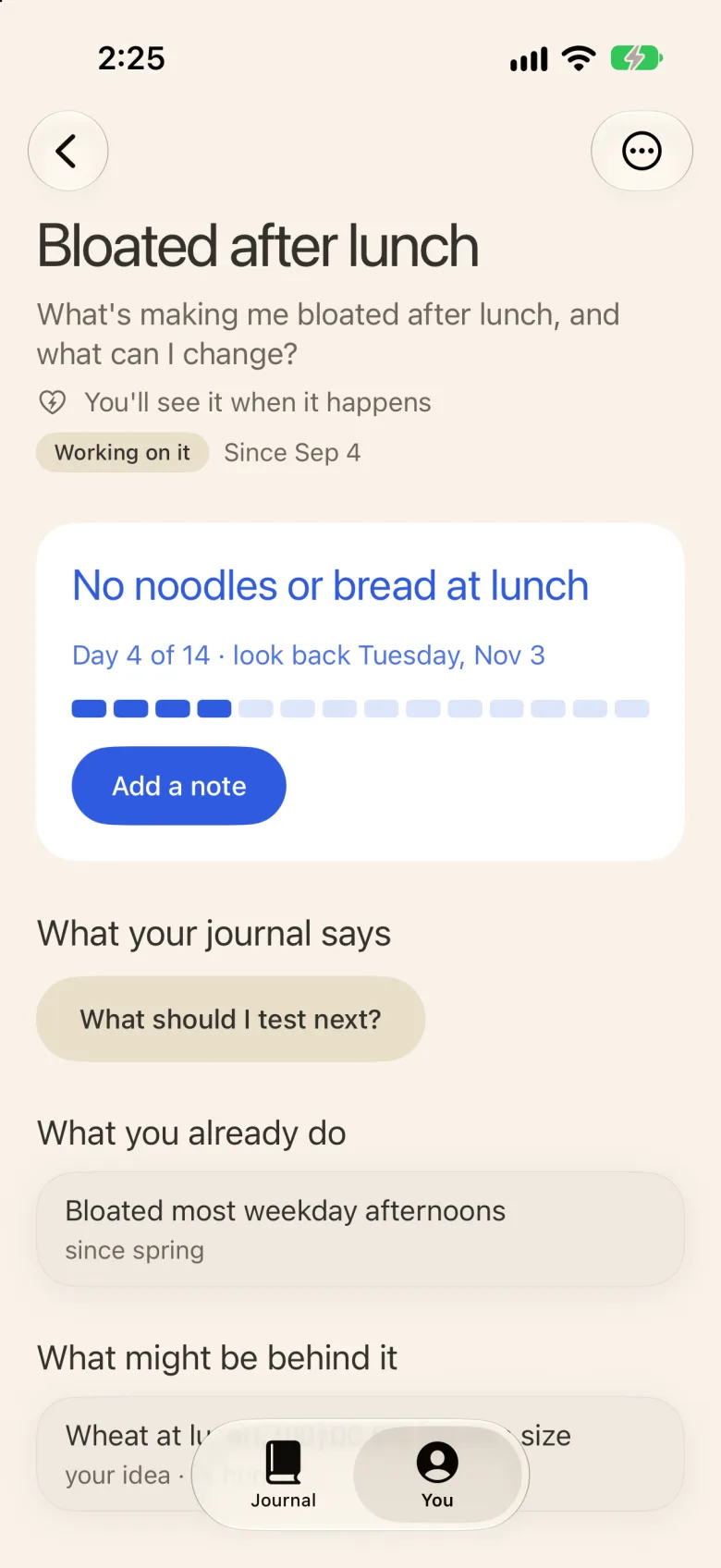
3. Her journal connects the dots
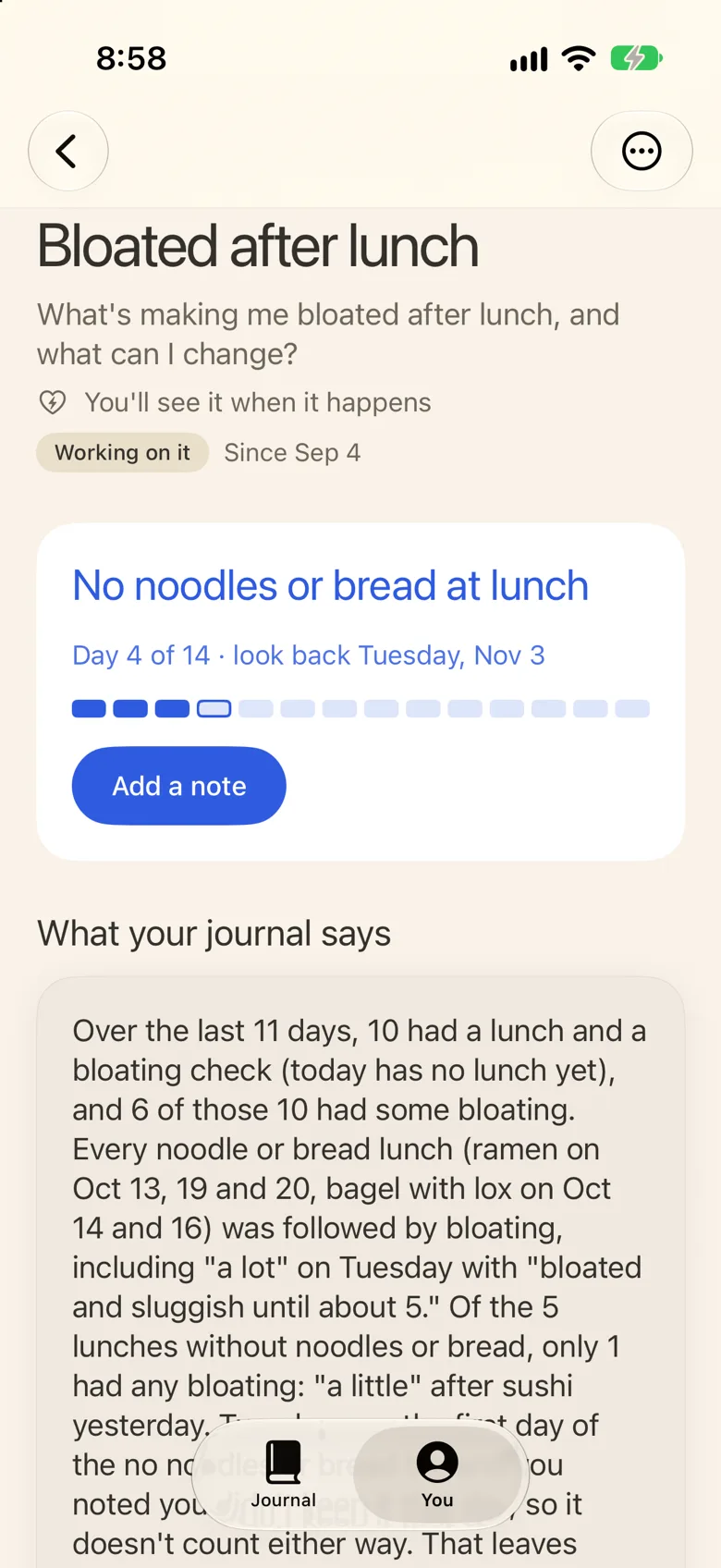
The finding shows up on her question's page, in counts and dates from her own entries. Her try cuts noodles and bread at lunch, so if celiac disease were possible, testing would come first.
4. She looks back
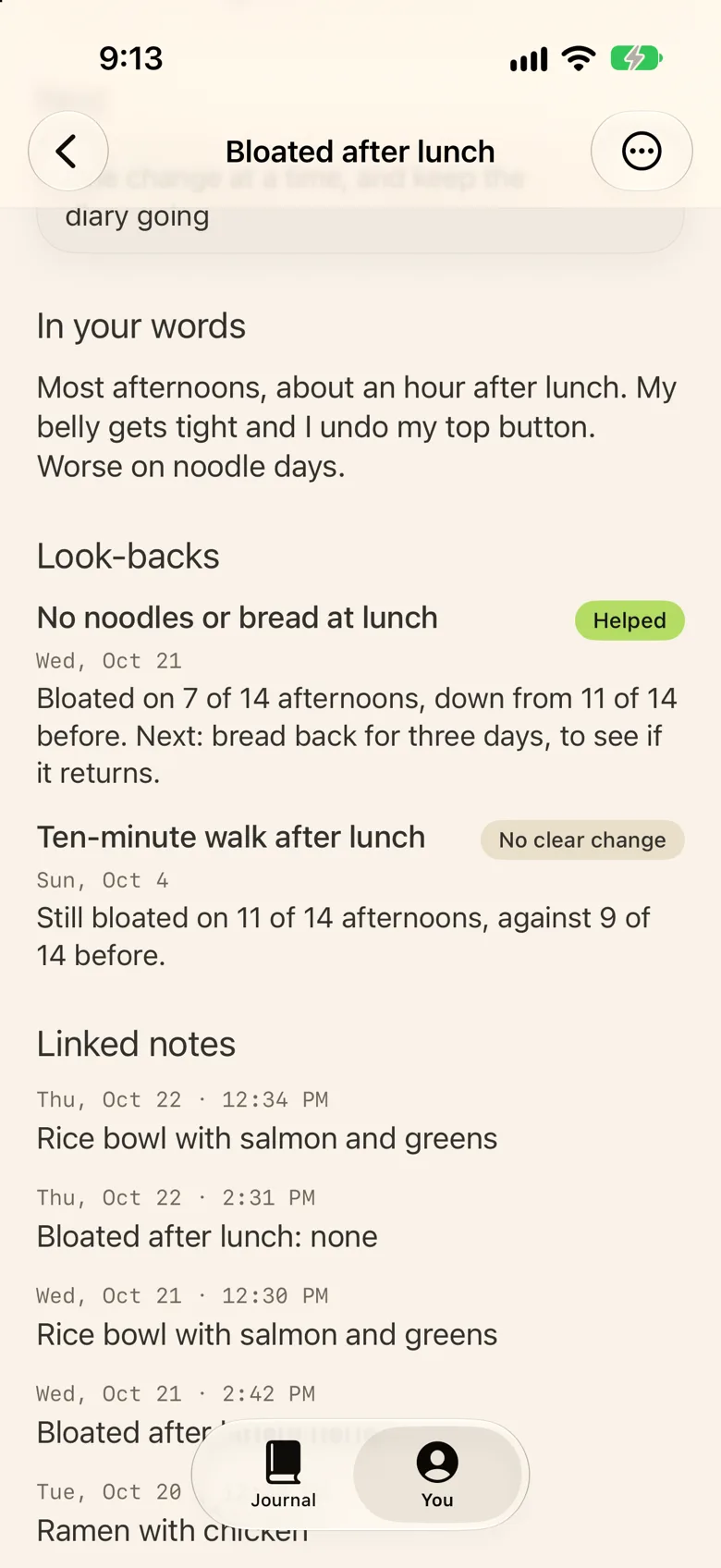
A look-back is a call on one try. It's a strong clue, and the guidelines' advice still holds: one change at a time, and a dietitian for anything bigger.
5. She takes it to the visit
When to see a doctor instead
A diary is for everyday discomfort that keeps coming back. See a doctor promptly if bloating or gut symptoms come with any of these:
- Blood in your stool, or stools that are black and tarry (NIDDK)
- Weight loss you can't explain (NHS)
- Anemia or low iron (ACG)
- New symptoms later in life, especially after 50 (ACG)
- A family history of bowel cancer, ovarian cancer, celiac disease, or inflammatory bowel disease (NIDDK, BDA)
- Diarrhea that wakes you at night (BSG 2021)
If you have ovaries, bloating that happens more than about 12 times a month is also worth raising with a doctor, especially at 50 or older, because it's one of the symptoms NICE lists for ovarian cancer checks (NICE NG12).
Call 911 for swelling of the lips, face, tongue, or throat, or trouble breathing after eating. Those are signs of a serious allergic reaction, which is a different problem from intolerance. If you've been prescribed epinephrine, MedlinePlus says to use it "as soon as possible, even before calling 911" (MedlinePlus).
Questions people ask
How long should an elimination diet last?
For low-FODMAP, Monash's first step lasts 2 to 6 weeks, followed by several weeks of reintroducing foods one group at a time. For cutting a single food, the NHS describes a few weeks before you start eating it again. We didn't find a guideline that gives one number for every change.
Does keeping a food diary actually help?
It's what clinicians ask for first, because it shows timing and patterns that are hard to remember. On its own, a diary rarely names a trigger. It helps most when you test one change against it.
What are the downsides of keeping a food diary?
It takes a little effort every day, and a long list of suspects can tempt you to cut many foods at once. The NHS advises against cutting foods out without advice from a GP or dietitian, and over-restricting can cost you nutrients. Keeping entries short, and testing one change at a time, avoids both.
Should I count calories in my food diary?
No. For gut symptoms, what matters is what you ate, when, and what happened afterward. Calorie counting adds effort without making triggers easier to see.
Should I use paper or an app?
Whichever you'll keep up. What matters is the time, the food, the symptom, and its strength, written the same day. IFFGD publishes a free printable daily diary if you'd like a paper version (IFFGD). Ours is one page a day, with a sheet for a two-week try. If you'd rather use an app, Best food diary app for IBS compares the ones made for it, Kasane included.
When should I see a dietitian?
The NHS suggests seeing a GP if you find you need to avoid lots of different foods to control your symptoms. If you're trying low-FODMAP, the British Society of Gastroenterology recommends a trained dietitian to guide it.