Many at-home food sensitivity tests measure IgG antibodies to foods, and the major allergy and gut organizations agree those results can't tell you which foods cause your symptoms. The method dietitians use instead is simpler: cut a suspect food, track your symptoms, then bring it back and see whether they return.
I get the appeal of the test. When you've felt off for months, a report that names your problem foods sounds like an answer. The trouble is what the test is actually measuring.
What an IgG test measures
IgG antibodies to a food mostly show that you've been eating it. The American Academy of Allergy, Asthma & Immunology says the IgG panel "has never been scientifically proven" to diagnose anything, and that higher IgG4 levels to a food "may simply be associated with tolerance" (AAAAI). In other words, a high number can mean your body is used to that food.
Canada's allergy society makes the same point from the other side: positive IgG results "are to be expected in normal, healthy adults and children" (CSACI). That's why these reports so often flag foods you eat every day.
The British Society of Gastroenterology gives a concrete example. In one trial, "IgG antibodies to yeast were reported in 87% of patients yet are rarely responsible for symptoms following dietary rechallenges" (BSG 2021).
A sign of exposure. IgG to foods is "found in all healthy people without food allergies" (BDA).
Possibly tolerance. Higher IgG4 "may simply be associated with tolerance" (AAAAI).
Not a basis for a diet. IgG-based elimination diets are "not recommended" in IBS (BSG).
Who says so
Organizations that disagree about plenty of other things line up on this one:
| Organization | What it says about IgG food testing |
|---|---|
| American Academy of Allergy, Asthma & Immunology | Lists it as an unproven test to avoid (Choosing Wisely) |
| European Academy of Allergy and Clinical Immunology | IgG4 to a food "does not indicate" allergy or intolerance (EAACI) |
| Canadian Society of Allergy and Clinical Immunology | "Strongly discourages" food-specific IgG testing (CSACI) |
| American College of Gastroenterology | IgG panels "have not been validated and cannot be recommended" (ACG 2021) |
| British Society of Gastroenterology | Elimination diets based on IgG are "not recommended" in IBS (BSG 2021) |
| NHS | Tests you can buy to diagnose intolerances "are not recommended" (NHS) |
The British Dietetic Association adds hair analysis, kinesiology, electrodermal, and leucocyte-antibody tests to the unproven list (BDA).
Why it can backfire
A test that flags a dozen foods can push you into a narrow diet you don't need. The NHS warns these tests "may suggest you should avoid multiple foods, which can be harmful." For kids, Canadian allergists note that test-driven exclusion diets carry risks of poor growth. And for someone with a real allergy, an IgG report can wrongly suggest a dangerous food is fine.
What works instead
For intolerance, the method dietitians use is cutting a food out and bringing it back while you track symptoms. The BDA describes a food as implicated when symptoms "improve when you cut out the food and return when it is reintroduced," ideally with a registered dietitian (BDA).
This is for intolerance, meaning uncomfortable symptoms like bloating, and it's best planned with a dietitian or doctor. If you think a food causes an allergic reaction, such as hives, swelling, or trouble breathing, don't test it yourself: allergy needs specialist input (BDA).
In practice:
- Keep a food and symptom diary for a week or two so you know what a normal week looks like. Here's how to keep one.
- Pick one suspect and remove it. One at a time, so the answer is clear.
- Give it a few weeks. The NHS describes starting to eat the food again "after a few weeks."
- Bring it back and watch. If symptoms ease without it and return with it, that's a strong clue. If they don't come back, call it no clear effect for now, at least at the amount you ate, and test the next suspect the same way.
The tests that do answer real questions
Some questions have a real test, and they're worth asking a doctor about. Each one answers something different:
| Test | What it tells you | When it helps |
|---|---|---|
| Cutting a food out, then bringing it back | Whether your symptoms follow that food | The method dietitians use for intolerance (BDA) |
| Hydrogen breath test | Whether your body absorbs lactose | Sometimes, after a trial without milk products (NIDDK); gut guidelines disagree on its use in IBS |
| Celiac blood test | Whether you have antibodies linked to celiac disease | Only while you're still eating gluten (NICE NG20); a specialist confirms the diagnosis (NHS) |
| IgE allergy test | Whether you're sensitized to a food, read alongside your reaction history | When your history suggests a food allergy (AAAAI) |
| IgG food panel | Mostly which foods you've been eating | Not recommended for finding triggers (see above) |
Celiac testing has one rule worth repeating: NICE advises gluten in more than one meal a day for at least 6 weeks beforehand, so don't go gluten-free before you're tested. And for allergy, the IgE test is a different test from the IgG panels, with a different purpose.
Start today
Print the pages
The printable food and symptom journal is one page a day for the baseline, and its two-week try sheet holds the cut-and-bring-back test: what you cut, the start date, a daily check-in, and the look-back.
Or ask your AI assistant to set it up
If you already use an AI assistant, this prompt walks you through the method dietitians use. It works in any capable assistant. Check its privacy practices before you share health details, and plan any change with your dietitian or doctor where you can.
Help me test whether one food is behind my symptoms, the way dietitians do it: keep a diary, cut one suspect, then bring it back and watch. Help me with the method only. Don't diagnose me or suggest IgG food sensitivity tests. If I describe swelling of my lips, face, tongue, or throat, trouble breathing, or a tight throat after eating, tell me to call 911 or my local emergency number now, and to use my epinephrine first if I've been prescribed it. If I describe hives or other reactions that keep coming back after a food, tell me to stop eating it and see a doctor, because allergy needs specialist input. If I mention blood in my stool, weight loss I can't explain, or that I'm avoiding more and more foods, tell me to see a doctor or dietitian first.

1. Ask what's bothering me and which food I suspect most.
2. Plan a week or two of my usual eating as a baseline, with a daily format: the time, the kind (meal, drink, symptom with a 0 to 3 strength, bowel movement), and what happened in my words.
3. If the suspect is gluten and celiac disease is possible, remind me to get tested first, while I'm still eating gluten.
4. Help me cut that one food for a few weeks, with a daily check-in answered none, a little, or a lot.
5. Then help me plan bringing it back, and what to watch for.
6. At the end, call it: symptoms eased without it and came back with it (a strong clue), no clear effect at the amount I ate, or needs another round. Then help me pick the next suspect, one at a time.
What it looks like in Kasane
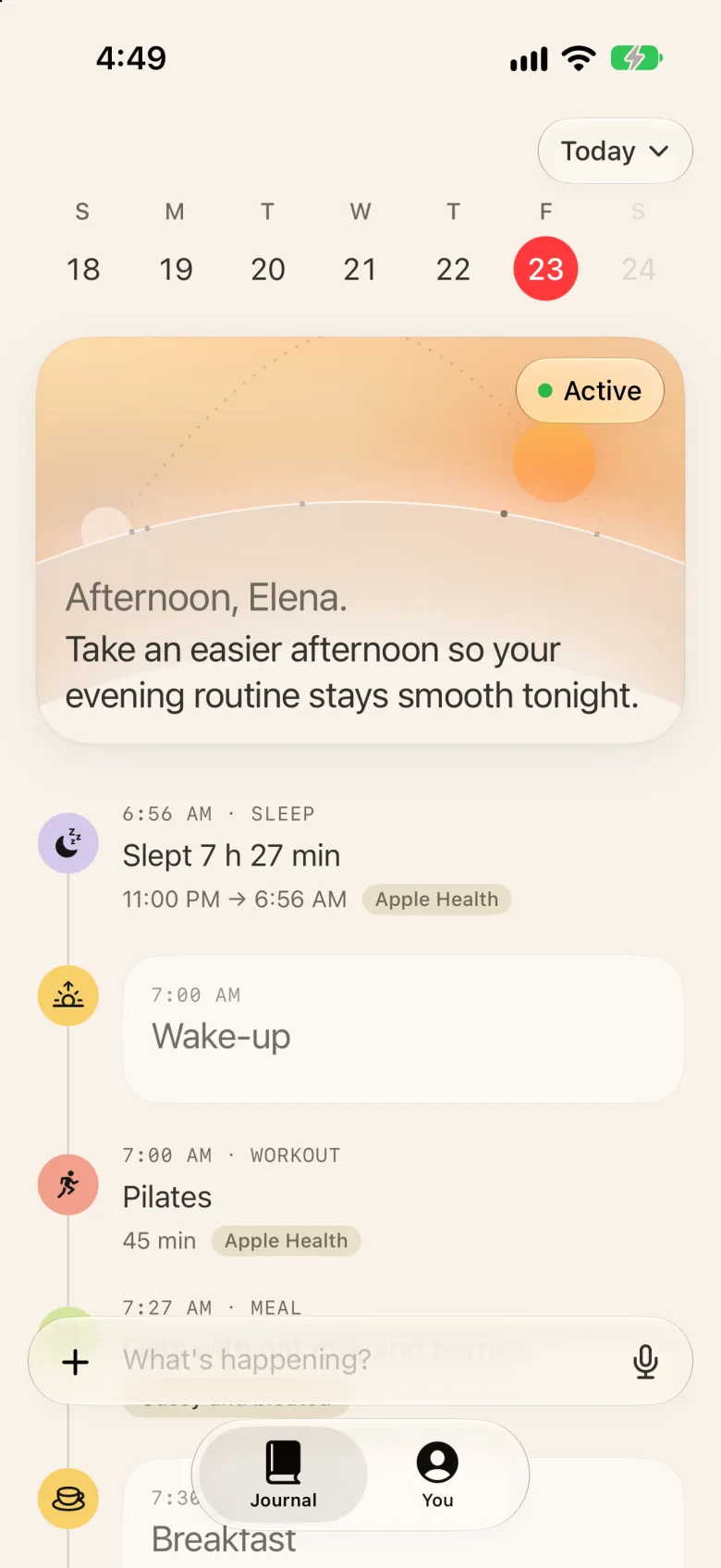
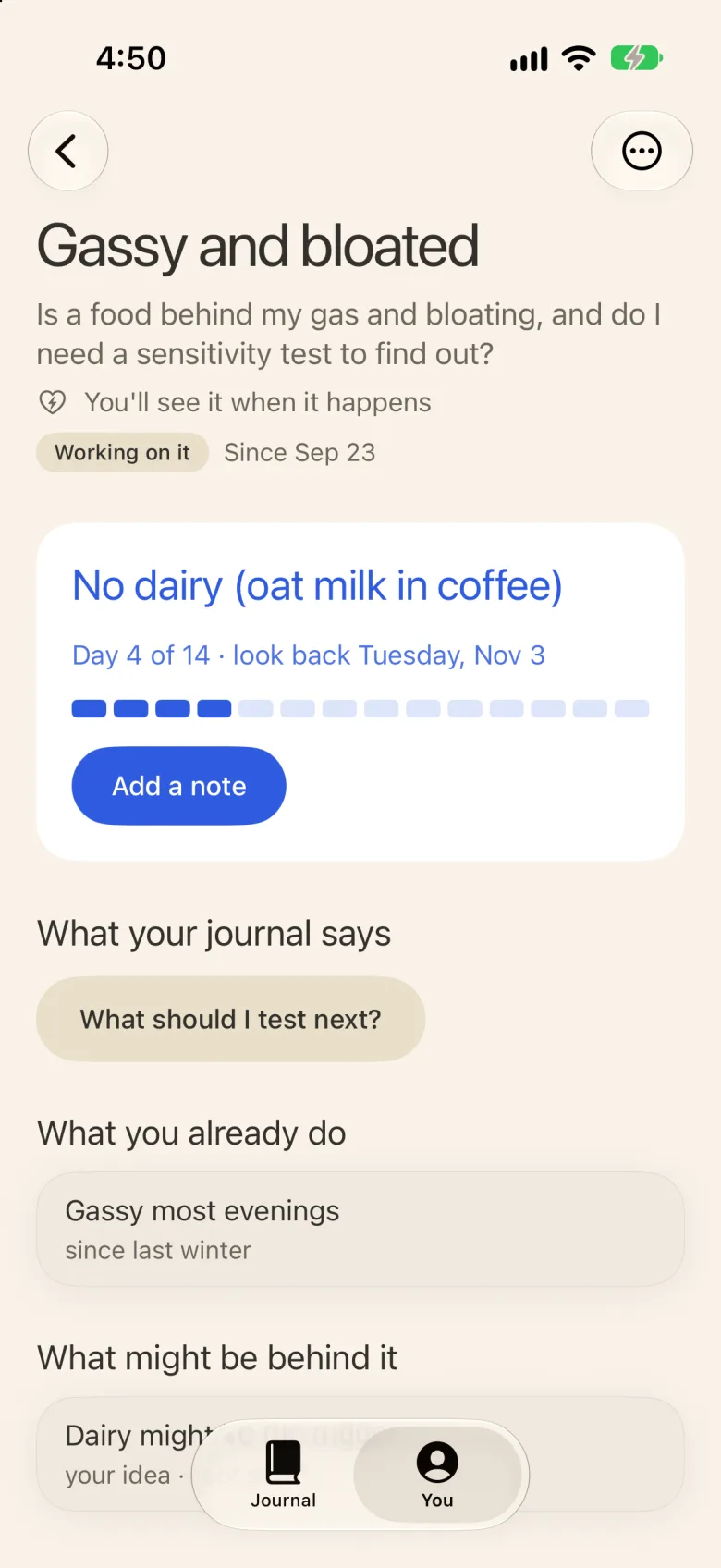
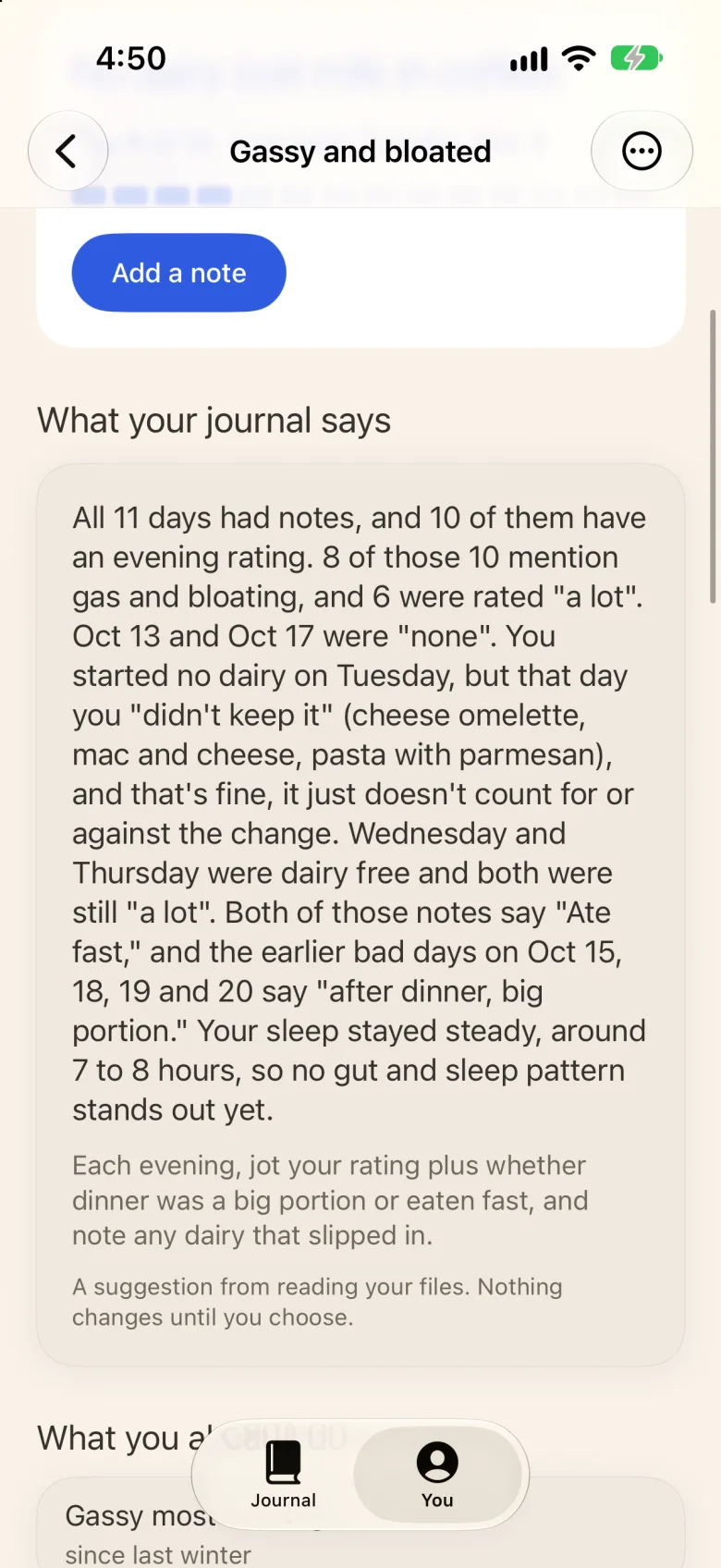
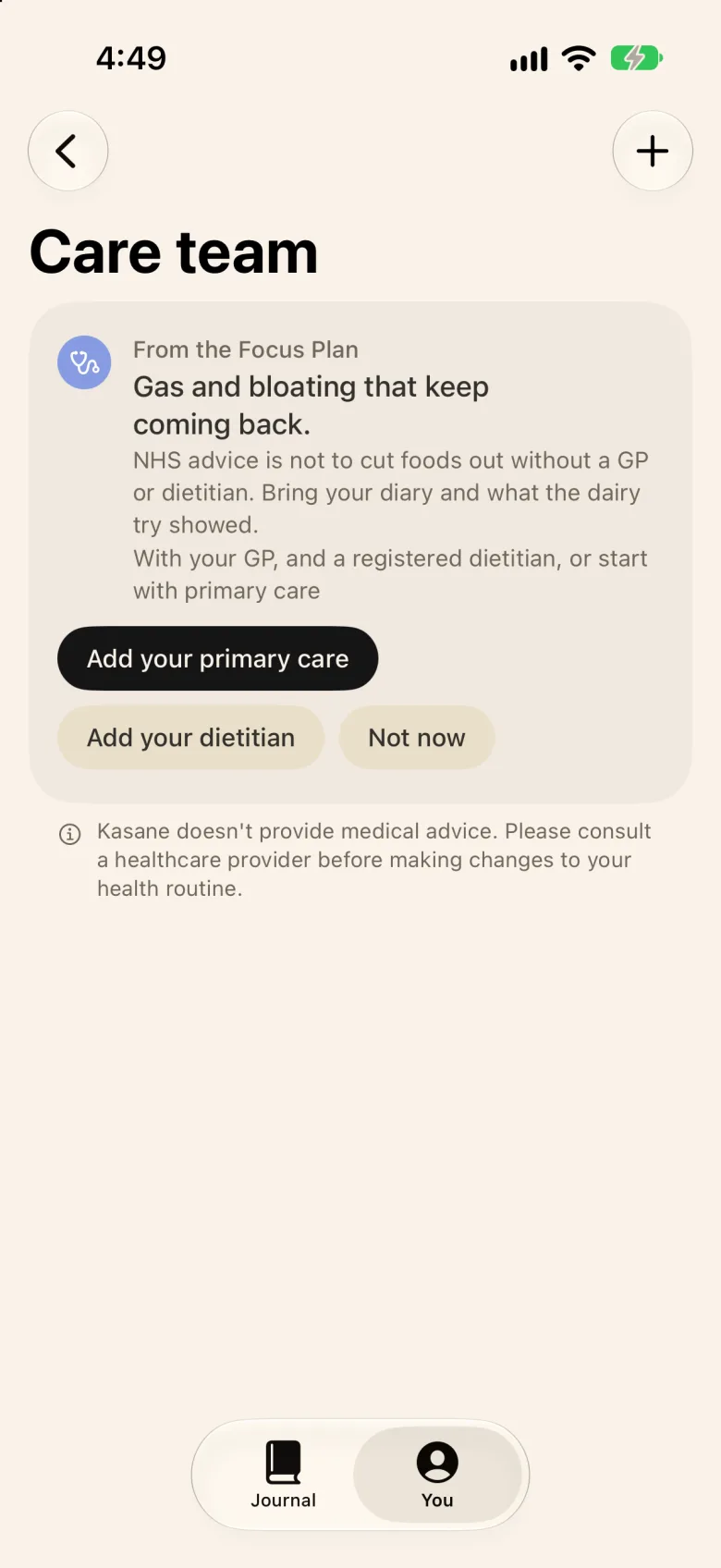
Kasane keeps the diary and the try that a sensitivity test can't replace. It's on the App Store for iPhone, starting with a free week: download Kasane. Here's a fictional example, step by step: Elena, gassy most evenings since last winter.
1. The day, as it happens
2. She names the question, and one change
3. Her journal connects the dots
4. She takes it to the visit
When to see a doctor
Call 911 for swelling of the lips, face, tongue, or throat, trouble breathing, or a tight throat after eating (MedlinePlus). If you've been prescribed epinephrine, use it as soon as possible, even before calling 911.
See a doctor for food reactions that keep coming back, or if you find yourself avoiding more and more foods to feel okay. Here's how to prepare for that appointment.
Questions people ask
Are food sensitivity tests accurate?
IgG tests measure antibodies, but those antibodies don't tell you which foods cause symptoms. Positive results are normal in healthy people and often reflect foods you eat regularly.
Is a food sensitivity test worth it?
Allergy and gut specialists in the US, Canada, Europe, and the UK recommend against IgG food tests for finding triggers. A structured elimination and reintroduction, ideally with a dietitian, is the method they support.
What's the best food sensitivity test for IBS?
Gut guidelines don't recommend an IgG test for IBS: the British Society of Gastroenterology says elimination diets based on IgG antibodies are "not recommended in patients with IBS." For finding a trigger, the supported method is cutting one food out and bringing it back, ideally with a dietitian. A doctor may also check for celiac disease, while you're still eating gluten.
Can I ask my doctor for a food sensitivity test?
Yes, and it's a good conversation to have, because a doctor can match the test to your actual question: a celiac blood test, an IgE allergy test if your history suggests a food allergy, or a breath test for lactose in some cases. For everyday symptoms, they may suggest cutting out and reintroducing one food at a time.
What's the difference between a food allergy and a food intolerance?
A food allergy involves the immune system and can be dangerous, which is why it needs an allergist. A food intolerance causes uncomfortable symptoms such as bloating, usually a few hours after eating (NHS).
Can a breath test find my food intolerance?
Sometimes. A hydrogen breath test can help identify lactose or fructose malabsorption, though gut specialists disagree about how useful it is for people with IBS. Ask your doctor whether it fits your situation.