To prepare for a gastroenterologist appointment, bring a one-page summary of your symptoms (when they started, how often, what makes them better or worse), what you've already tried and how it went, every medicine and supplement you take, and your three most important questions. Put the most important question first.
Appointments go fast, and months of symptoms are hard to explain from memory. A page you can hand over, with your detailed notes behind it, helps the doctor see the pattern and leaves time for your questions. If your notes go back years, here's how to turn them into one page.
What to expect at the first visit
A first visit is mostly conversation. For gut symptoms like IBS, "doctors review your symptoms and medical and family history and perform a physical exam," which can include tapping on your abdomen to check for tenderness or pain. "In some cases, doctors may order tests to rule out other health problems" (NIDDK).
If you've had tests before, IFFGD suggests you "mention tests and procedures you have completed and (if possible) bring those results to the visit" (IFFGD).
Procedures are different from a consultation. Before an upper endoscopy, for example, "your doctor may ask you not to eat or drink for up to 8 hours" (NIDDK), and a colonoscopy comes with written bowel prep instructions (NIDDK). For a first consultation, follow whatever your clinic tells you when you book.
What a GI doctor will ask
The National Institute on Aging's guidance lists the questions doctors ask about any symptom: when it started, what time of day it happens, how long it lasts, how often, whether it's getting better or worse, and whether it stops you doing your usual things (NIA).
For gut symptoms, NIDDK adds family history of digestive diseases such as celiac disease, colon cancer, and inflammatory bowel disease, your medicines, recent infections, stressful events around when symptoms started, and what you eat (NIDDK).
Timing is part of the picture too. NIDDK says a doctor may diagnose IBS if symptoms such as belly pain linked to bowel movements have happened at least once a week in the last three months and first started at least six months ago, and that they may diagnose it even if you've had symptoms for a shorter time. So there's no need to wait before you go. If you know roughly when yours started, write it down.
The one-page summary
Here's a template built from those questions. Keep each line short: the NIA's advice is to be clear and concise.
| Section | What to write |
|---|---|
| Main concern | One line in your own words, e.g. "Bloated most afternoons for about a year" |
| When it started | Month and year, and anything that was going on then |
| Pattern | How often, what time of day, how long it lasts, better or worse lately |
| What makes it better or worse | Foods, meals, stress, sleep, your cycle, exercise |
| Bowel habits | Frequency and stool type on the Bristol Stool Form Scale |
| Impact | What it stops you doing, or makes harder |
| Already tried | Each change, how long you tried it, and what happened |
| Medicines and supplements | Names and doses, including over-the-counter and vitamins |
| Family history | Celiac disease, IBD, colon or ovarian cancer |
| Warning signs | Yes or no for each item in the list below |
| Top three questions | Most important first |
- When it started
- Around September last year, after a stomach bug on a trip
- Pattern
- 4 or 5 days a week, mid-afternoon, lasts 2–3 hours, a little worse lately
- Better or worse
- Worse after big lunches and on stressful days
- Bowel habits
- Once a day, mostly Type 4, sometimes Type 6
- Impact
- Skipping afternoon plans on bad days
- Already tried
- Less coffee, 2 weeks: no clear effect
Lunch away from the desk, 3 weeks: fewer bad days - Medicines and supplements
- Multivitamin, daily · Ibuprofen 200 mg, about twice a month
- Family history
- Aunt with celiac disease
- What do you think is most likely, and what else are you considering?
- Do I need any tests, and should I keep eating normally until then?
- Would it help to work with a dietitian?
A few tips make it more useful. AHRQ suggests bringing "all the medicines you take" to the appointment, because doses are easy to misremember; photos of the labels are a handy backup (AHRQ). Keep your food and symptom diary with you in case the doctor wants detail, but lead with the summary. And if you can, bring someone: the NIA notes a companion can remind you what you planned to discuss and take notes.
Questions worth asking
Start with your own top three. These are good additions, several adapted from AHRQ's list of questions to ask:
- What do you think is most likely, and what else are you considering?
- What is this test for, and when will I get the results?
- Is there anything I should keep eating, or avoid changing, before a test?
- Would it help to work with a dietitian?
- What should I track between now and our next visit?
- Which symptoms should make me call before then?
The question about not changing anything is worth asking directly. Celiac testing, for example, only works while you're still eating gluten, in more than one meal a day for at least six weeks beforehand (NICE NG20).
Start today
Print the pages
For the weeks before the visit, print the food and symptom journal, one page a day. For the page you bring, the visit notes and next-visit list follow the summary above, and the medication list covers medicines and doses.
Or ask your AI assistant to set it up
If you already use an AI assistant, this prompt walks you through the weeks before the appointment. It works in any capable assistant. Check its privacy practices before you share health details.
Help me prepare for a gastroenterologist appointment over the weeks before it. Help me organize my notes, without diagnosing me or suggesting treatments. If I mention blood in my stool, black or tarry stools, weight loss I can't explain, diarrhea that wakes me at night, or severe pain, tell me to contact a doctor now.

1. Ask what's bothering me, and write my main concern as one line in my words.
2. Until the visit, give me a daily format with one line per entry: the time, the kind (meal, symptom with a 0 to 3 strength, bowel movement by Bristol type, medicine, stress, sleep), and what happened in my words.
3. Ask me when it started, how often it happens, what time of day, how long it lasts, whether it's getting better or worse, and what it stops me doing.
4. Ask what I've already tried, for how long, and what happened, including "no clear effect."
5. Remind me not to cut out gluten or other foods before testing unless my doctor asks, and not to stop prescribed medicines on my own.
6. A few days before the visit, help me build one page: main concern, when it started, pattern, what makes it better or worse, bowel habits, impact, already tried, medicines and supplements with doses, family history, warning signs (yes or no for each), and my top three questions, most important first. Keep my wording and mark anything uncertain.
What it looks like in Kasane
In Kasane, the weeks before a visit are the journal itself. It's on the App Store for iPhone, starting with a free week: download Kasane. Here's the fictional Priya from the food diary guide, whose question page reads her days back to her.
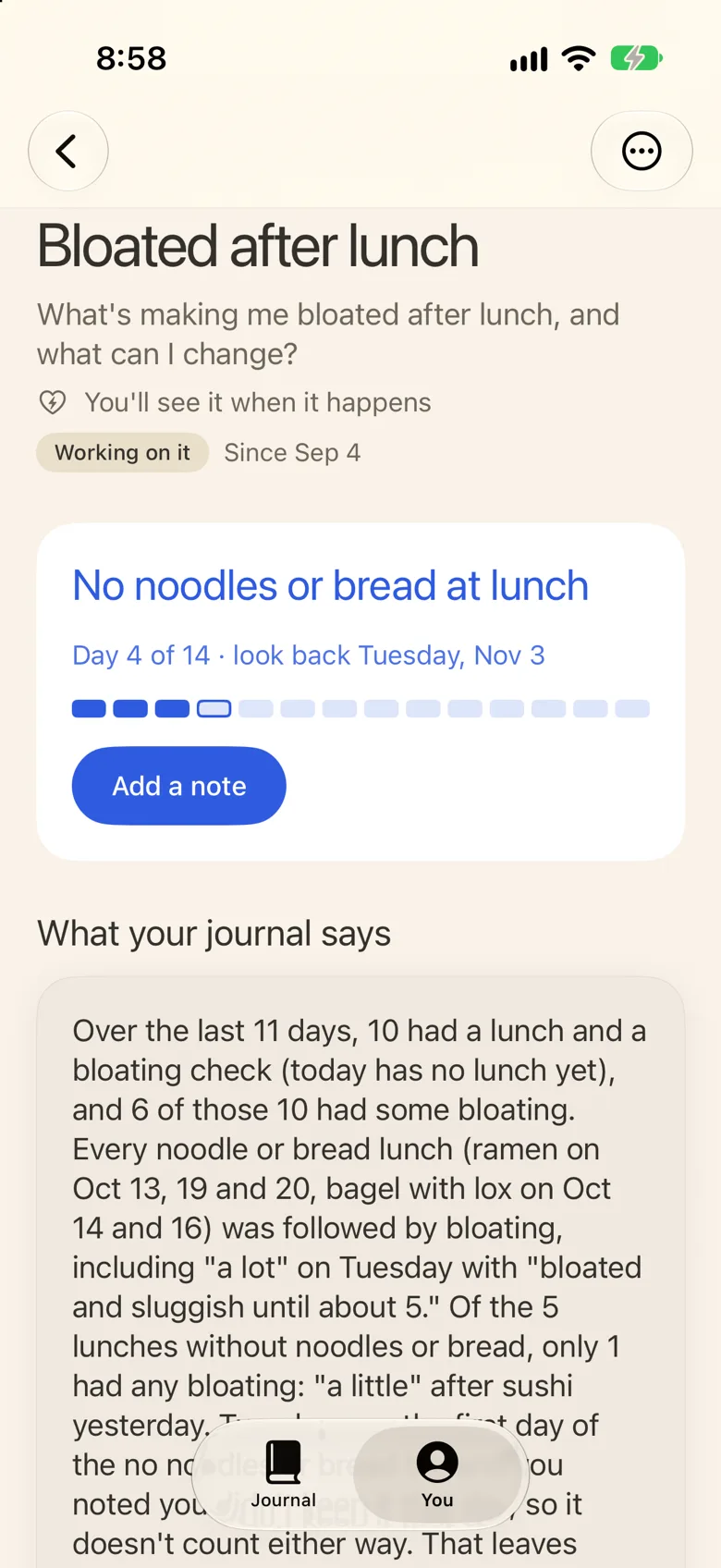
Each person on your care team also has a "For the next visit" list, where questions collect as they come up. Before Priya has added anyone, her Care team already suggests what to bring and who to see:
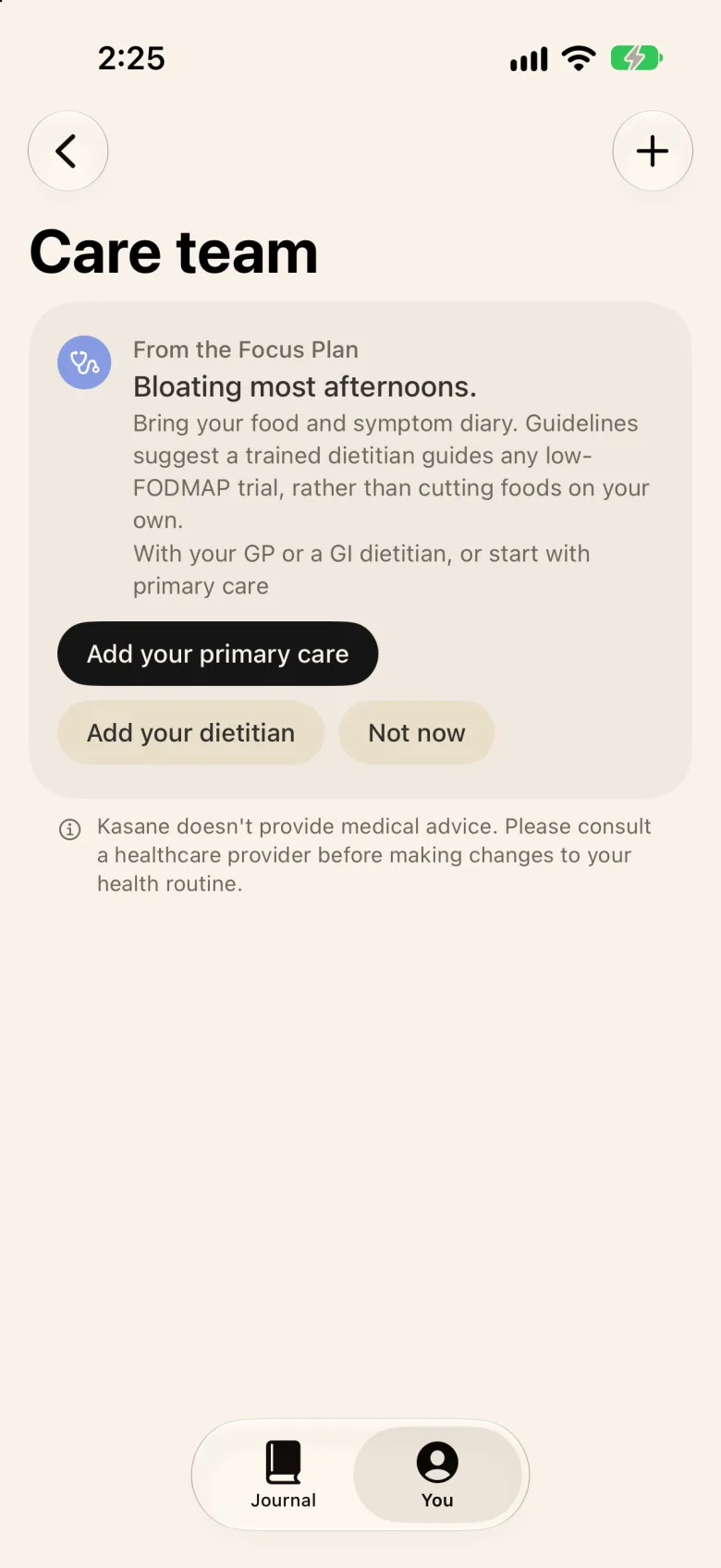
The page you hand over is still yours to write, and the counts and dates make its pattern lines quick to fill in.
Warning signs to mention first
Put these at the top of your summary if any apply:
- Blood in your stool, or black and tarry stools (NIDDK)
- Weight loss you can't explain (ACG)
- Anemia or low iron (ACG)
- Symptoms that started later in life, especially after 50 (ACG)
- Diarrhea that wakes you at night (BSG 2021)
- A family history of bowel cancer, ovarian cancer, celiac disease, or IBD (NIDDK, BDA)
Don't wait for the appointment if you have severe stomach pain that came on suddenly, are vomiting blood, or have trouble breathing. Call 911 or go to an emergency room (NHS).
Questions people ask
What should I bring to my first gastroenterologist appointment?
A one-page summary of your symptoms and what you've tried, a complete list of medicines and supplements with doses (or the bottles themselves), any previous test results, your family history, and your top three questions written down.
What does a gastroenterologist do on the first visit?
Mostly they listen and ask questions: about your symptoms, your medical and family history, your medicines, and what you eat. They'll often examine your abdomen, and they may order tests afterward to rule out other problems.
What should I not do before a gastroenterologist appointment?
Don't cut out gluten or other foods before testing unless your doctor asks you to, because some tests need you to keep eating them. Don't stop prescribed medicines on your own. And follow any instructions your clinic sends, especially before a procedure.
How do I describe my symptoms to a doctor?
Cover when they started, how often they happen, what time of day, how long they last, whether they're getting better or worse, what makes them better or worse, and how they affect your daily life. Be specific and concise.
Should I bring my whole food diary?
Bring it, but lead with a one-page summary. Doctors have limited time, and the summary helps them see the pattern quickly. The diary is there if they want to look closer.
What questions should I ask a gastroenterologist about IBS?
Ask what they think is most likely and why, whether any tests are needed and what they're for, whether a dietitian or a diet like low-FODMAP makes sense for you, what to track before your next visit, and which symptoms should prompt a call sooner.